In brief
The U.S. Space Force, operating from Buckley Space Force Base in Colorado, is on high alert, tracking missile launches globally and preparing for potential conflict in space, amid growing military tensions with adversaries like China and Russia.
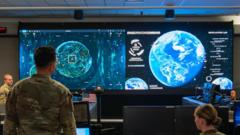
In a striking display of modern military operations, members of the U.S. Space Force, referred to as "Guardians," engage in real-time missile tracking exercises at Buckley Space Force Base, Colorado. Amid the hum of technology and focused demeanor, a commanding shout pierces through: "Launch Yemen!" Immediately, every Guardian responds in unison, "Copy, launch Yemen," illustrating their readiness to monitor threats from any corner of the globe. This operation room, a critical hub for missile warning and tracking, is a 24/7 nerve center, with vast screens displaying data from military satellites. Recently, during a live drill simulating missile launches, Colonel Ann Hughes reflected on the seriousness of real scenarios. The base was put to the test last month when Iran fired missiles targeting U.S. military operations in Qatar. Due to prior warnings, the Guardians successfully tracked those missiles and coordinated defenses, ultimately safeguarding personnel on the ground—a testament to their integral role in contemporary defense strategies. As geopolitical tensions rise, particularly concerning conflicts in the Middle East and Europe, Colonel Hughes emphasized their increasing importance, stating, "We provide strategic and tactical missile warnings to all U.S. and allied forces." Although the specifics remain unconfirmed by the U.S., it is believed that intelligence may have been shared with Ukraine regarding potential Russian offensives. The Buckley Space Force Base is a pivotal player in the ambitious Golden Dome missile defense initiative, proposed by former President Donald Trump. With proposed funding of $175 billion aimed at strengthening U.S. missile defense, the project draws inspiration from Israel's Iron Dome system. The area is marked by prominent radomes housing advanced satellite capabilities, essential for tracking the ever-evolving threats posed by adversaries like Russia and China, who are pushing the boundaries of missile technology. Lieutenant General David Miller underscored the geopolitical landscape's shifting nature, expressing concern over hypersonic missiles and emerging military technology. He stressed the necessity for space-based interceptors in defending against these modern threats. Trump initiated the establishment of the Space Force, re-establishing the military domain as one increasingly contested in the realm of outer space. As tensions rise, Colonel Phoenix Hauser, overseeing intelligence operations, detailed how close encounters between satellites have escalated. "We're already sparring in space," she remarked. This statement underscores the urgency of U.S. preparedness as rival nations engage in practices that could threaten space security, entailing the use of electronic warfare and movable satellite technology. In light of recent operations, the U.S. Space Force has adapted its approach, enhancing offensive capabilities in space operations. General Miller emphasized, "The only way to prevent conflict is through strength," signaling a shift in strategy and the importance of maintaining dominance in space for national security. Additionally, the U.S. Space Force played a critical role in the recent military strike on Iran's nuclear capabilities, referred to as Operation Midnight Hammer. Their strategic communication and electronic warfare capabilities allowed U.S. forces to execute missions with an element of surprise, crucial for successful operations. Commanders cited their ability to jam enemy communications and monitor the electromagnetic spectrum as essential to maintaining operational integrity. The youngest branch of the U.S. military, tasked with ensuring ongoing dominance in space, continues to evolve, growing in significance as global military dynamics change. In General Miller's words, any adversary should recognize the ramifications of the U.S. military's focus: "God help you!"