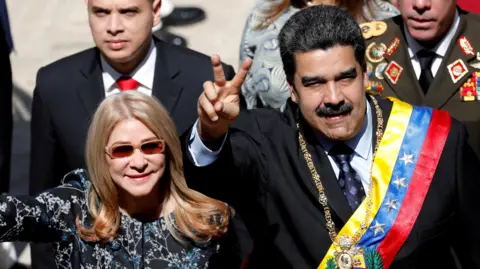
The US has captured Venezuela's President Nicolás Maduro after a large-scale strike on the South American country, US President Donald Trump has said.
Trump stated that Maduro and his wife were taken from the country in a military operation in coordination with US law enforcement.
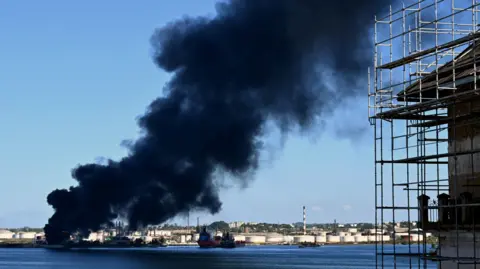
Explosions were reported across Venezuela's capital, Caracas, early Saturday morning, notably at military bases.
The Venezuelan government has demanded proof of Maduro's wellbeing, simultaneously deploying its armed forces and declaring a national emergency.
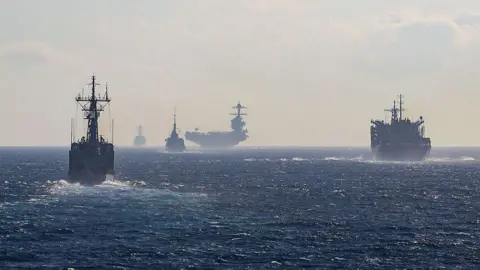
Maduro's capture follows increased tensions between the two nations, with the US targeting boats in the Caribbean allegedly used for drug trafficking.
The US accuses Maduro of being involved in drug-smuggling and calls him an illegitimate leader, while Maduro claims the US is attempting to intimidate Venezuela.
What do we know so far regarding Maduro's capture? Not many details have been disclosed about how Maduro was detained or his current whereabouts.
According to CBS, Maduro was captured by the US army’s Delta force—its top counter-terrorism unit.
Trump is scheduled to hold a news conference at his Mar-a-Lago residence in Florida at 11:00 EST (16:00 GMT) to reveal more details about the operation.
During the strikes, loud explosions were heard throughout Caracas around 2:00 local time (6:00 GMT), with reports of military and civilian areas being hit, notably at military airfield La Carlota and Fuerte Tiuna, a major military base.
Videos circulating on social media depict explosions and helicopters flying overhead, although these have yet to be verified. Currently, information regarding casualties is unclear.
Venezuelan Vice-President Delcy Rodríguez has expressed concern over the whereabouts of Maduro and his wife, demanding immediate proof of life, while the defense minister claims the strikes impacted civilian areas and the government is assessing casualties.
In an official statement, the Venezuelan government condemned what it describes as a serious military aggression by the US, accusing it of threatening international peace and stability while trying to control Venezuela's strategic resources.
Trump later confirmed via his social media platform that the US operated a large-scale strike against Maduro and stated that details would follow.
Nicolás Maduro, who succeeded Hugo Chávez as president in 2013, has been involved in ongoing disputes with Trump, especially concerning Venezuelan migrants entering the US and the drug trade.
The US previously offered a reward for information leading to Maduro's arrest, accusing him of leading drug gangs and denying his claims of innocence, which he argues are part of a US strategy to take control of Venezuela's oil reserves.