In brief
Former US President Donald Trump has expressed a willingness to increase military intervention in Nigeria if the violence against Christians does not cease. This warning follows recent airstrikes targeting Islamist militants, and his comments have sparked debate regarding the ongoing religious tensions in the region.
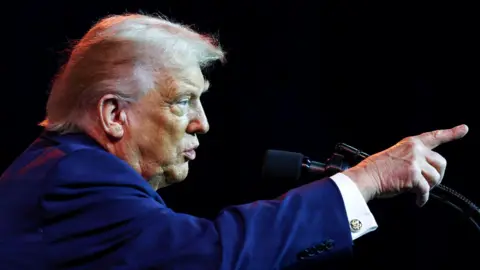
US President Donald Trump has warned that he could order more airstrikes on Nigeria if Christians continue to be killed in the West African nation.
In a wide-ranging interview with the New York Times, Trump was asked whether the Christmas Day strikes in Nigeria's northern Sokoto state, targeting Islamist militants, were part of a broader military campaign.
I'd love to make it a one-time strike. But if they continue to kill Christians it will be a many-time strike, he said.
Nigeria's government has rejected Trump's earlier accusations that it is failing to protect Christians from jihadist attacks, saying that Muslims, Christians and those of no faith alike are targeted.
Claims of a genocide against Nigeria's Christians began circulating last year in some right-wing US circles - but organisations monitoring political violence in Nigeria say most victims of the jihadist groups are Muslims.
When questioned about this in the interview published on Thursday, Trump replied: I think that Muslims are being killed also in Nigeria. But it's mostly Christians.
Nigeria's population of more than 230 million people is roughly evenly divided among Christians, who predominate in the south, and Muslims, who are mostly in the north.
For the past 15 years, the north-east of the country has suffered from a devastating Islamist insurgency at the hands of jihadist groups such as Boko Haram and those affiliated with the Islamic State (IS) group, based in Borno state.
The US's Christmas Day strikes hit two camps run by a jihadist group called Lakurawa in the largely Muslim state of Sokoto, in north-western Nigeria near the border with Niger. It is still unclear if there were any casualties as neither the US nor Nigerian government has provided figures.
The foreign minister of Nigeria stated that the strikes were part of a joint operation and had nothing to do with a particular religion, despite Trump's claims that he had ordered them as a Christmas present. The minister added that the strikes had explicit approval from Nigeria's President Bola Tinubu and involved the country's armed forces.