In brief
A collection of forgotten photographs reveals the significant but underappreciated role women played in India's civil disobedience movement against British colonial rule in the 1930s. This newfound visual evidence highlights how women not only participated but often led the political activities during this crucial period in history. Several prominent figures, along with countless unsung heroes, are spotlighted as they challenged colonial authority, embraced new technologies, and redefined societal roles. The album is now part of ongoing exhibitions aiming to recognize the crucial part these women played in India's journey to independence.
In India, a set of recently discovered photographs is drawing attention to the role of women in one of the country's biggest anti-colonial movements, known as the civil disobedience movement, led by Mahatma Gandhi in 1930-31.
The images do not simply capture female participation. They are visual proof of how women commanded and dominated political activity, often relegating men to the sidelines.
In April 1930, Gandhi concluded his pivotal salt march, breaking the British monopoly on salt production - a charged symbol of colonial misrule. Raising a handful of muddy salt from the sea, he declared himself to be shaking the foundations of the British Empire.
Afterwards, Gandhi presided over waves of civil disobedience protests, encouraging supporters of the Indian National Congress to manufacture contraband salt, boycott foreign goods, and face down phalanxes of lathi-wielding policemen. Just a few months before, the Congress had declared purna swaraj (complete independence) as its political objective for India.
Historians have long recognised the civil disobedience movement as an important turning point in Indian politics.
First, women joined anti-colonial activities in greater numbers. When Gandhi began his salt march he forbade women from joining, but several female leaders convinced him to accord them a greater role.
Second, Congress leaders harnessed modern media technologies like radio, film, and photography, which helped their political struggle reach an international audience.
About 20 years ago, one album of photographs from the movement appeared at a London auction. The Alkazi Foundation, a Delhi-based art collection, acquired the album.
The album gave few clues about its provenance. Scrawled on its spine were the words Collections of Photographs of Old Congress Party - K. L. Nursey. Despite its unknown origins, the photographs told a dramatic and detailed story.
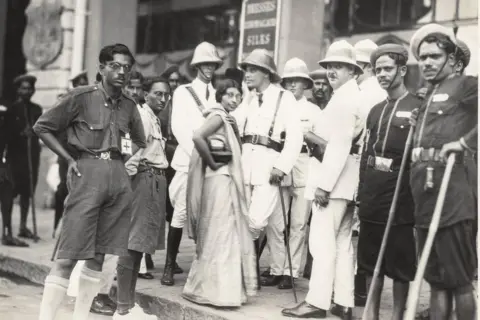
These images describe the streets of Bombay, showcasing non-posed images of violent confrontations with police, wounded volunteers loaded onto ambulances, and boisterous marches amidst monsoonal downpours.
Above all, the album brings to light how women used the civil disobedience movement for their empowerment.
As many female volunteers brought along their young daughters, they were inducting new generations of women into anticolonial politics. They claimed freedom from colonial rule but also from the prevailing gendered division of spaces.
The Nursey album is a stunning testament to the urban transformation of Bombay, creating a narrative showing women at the forefront of nationalist activities while also exploring the shifting balance of societal roles.
Ramaswamy and her colleague Avrati Bhatnagar released a book titled, Photograhing Civil Disobedience, including many of the images alongside scholarly articles. Exhibits titled Disobedient Subjects are open at the CSMVS Museum in Mumbai and Duke's Center for Documentary Studies.
Women volunteers during the civil disobedience movement are receiving overdue recognition for their role in this historic struggle.