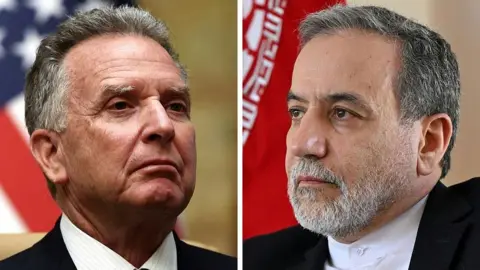
Senior US and Iranian officials are set to continue discussions after talks in Oman, the Iranian foreign minister says, amid a crisis that had raised fears of a conflict between the countries. Abbas Araghchi said the mediated discussions were a good beginning and exclusively nuclear, and the negotiators would now return to their capitals for consultations.
Ahead of the talks, US officials expressed a desire to discuss Iran's ballistic missiles and its support for regional armed groups, which underscores the gaps between the countries' positions. There has been no immediate US reaction to the discussions.
The talks came against the backdrop of a US military buildup in the Middle East in response to Iran's violent repression of nationwide anti-government protests last month, which human rights groups claim resulted in thousands of fatalities. President Trump has also threatened military action against Iran if a deal is not reached, adding to the tension in the region.
Iran, meanwhile, has vowed to respond aggressively to any attack, threatening to strike American military assets and Israel. Speaking to Iranian state television, Araghchi noted that there exists an atmosphere of mistrust that must be overcome, with details about the next round of talks to be determined later.
The discussions were mediated by Oman's Foreign Minister Badr Albusaidi, who described them as useful in clarifying both Iranian and American perspectives. This marks the first official engagement between US and Iranian officials since before the conflict that escalated last June.
The outcome of these negotiations is uncertain, as significant differences persist, particularly regarding Iran's nuclear program and ballistic missile capabilities. The proceedings may provide a crucial off-ramp from military confrontation for both countries.
Ahead of the talks, US officials expressed a desire to discuss Iran's ballistic missiles and its support for regional armed groups, which underscores the gaps between the countries' positions. There has been no immediate US reaction to the discussions.
The talks came against the backdrop of a US military buildup in the Middle East in response to Iran's violent repression of nationwide anti-government protests last month, which human rights groups claim resulted in thousands of fatalities. President Trump has also threatened military action against Iran if a deal is not reached, adding to the tension in the region.
Iran, meanwhile, has vowed to respond aggressively to any attack, threatening to strike American military assets and Israel. Speaking to Iranian state television, Araghchi noted that there exists an atmosphere of mistrust that must be overcome, with details about the next round of talks to be determined later.
The discussions were mediated by Oman's Foreign Minister Badr Albusaidi, who described them as useful in clarifying both Iranian and American perspectives. This marks the first official engagement between US and Iranian officials since before the conflict that escalated last June.
The outcome of these negotiations is uncertain, as significant differences persist, particularly regarding Iran's nuclear program and ballistic missile capabilities. The proceedings may provide a crucial off-ramp from military confrontation for both countries.