In brief
The launch of Shenzhou 19 marks a significant moment in China's space race, as three young taikonauts begin their journey to the Tiangong space station. This mission underscores China's ambition to stake its claim in space exploration and potentially on the Moon, raising international concerns and a new space rivalry.
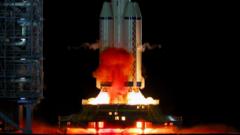
As the ground shakes beneath us, the countdown for the Shenzhou 19 rocket ends with a spectacular launch from the Jiuquan Satellite Launch Center in the Gobi Desert. Flames erupt from the base of the rocket, illuminating the dark sky and erupting into a thunderous roar that fills the air. The BBC received the rare opportunity to observe this monumental event just over a kilometer away from the launch site.The crew of three taikonauts, China's term for astronauts, is embarking on a mission to China's space station, known as Tiangong, or "Heavenly Palace." They will spend six months conducting various experiments and spacewalks, acquiring essential skills for China's ambitious goal of sending a crewed mission to the Moon by 2030. President Xi Jinping previously declared a vision for China to become a leading space power, and current activities are reflective of this ambition.In contrast, some officials in Washington express concern over China’s rapid advancements in space technology. NASA Administrator Bill Nelson noted that the U.S. and China are in a race to return to the Moon, with fears that Beijing may be seeking to establish territorial claims.The launch event, held in Dongfeng Space City, showcases incredible national pride. Streets are lined with flags and festive decorations, while crowds gather past midnight, flag-waving in excitement as the taikonauts take their final steps on Earth. Cai Xuzhe, the veteran pilot of this mission, expresses confidence in his younger colleagues – including Wang Haoze, the first female space engineer from China – stating, “Inspired by dreams that spark glory, we will strive to achieve new accomplishments in China’s crewed space programme.”The trio represents China's youngest crew to date, reflecting the nation's investment in nurturing a new generation of space explorers. With future lunar missions on the horizon, Chinese officials have already selected a new group of astronauts to undergo training for upcoming projects.As China celebrates its advancements in space exploration, it has recently achieved historic milestones, such as retrieving samples from the far side of the Moon and deploying the Zhurong rover on Mars. Plans include establishing a vast satellite network to rival SpaceX’s Starlink.American officials voice escalating fears about China's potential weaponization of space technology amid this newfound competition. General Stephen Whiting has noted China's significant investments in military-oriented satellite systems that heighten security concerns.While the Chinese government asserts its commitment to peaceful space exploration, the definitions of cooperation and competition are blurring as countries vie for control of resources beyond Earth. The Moon is believed to hold valuable minerals and resources, further fuelling the space race for dominance.Experts at the launch site emphasize the significance of experiments aboard the Tiangong space station, explaining that research into the effects of microgravity might yield critical medical advancements applicable to life on Earth. Nevertheless, despite a booming space programme, some officials downplay achievements as they face numerous challenges ahead.President Xi remains focused on boosting the space programme even amid economic headwinds, illustrating its priority on the national agenda. The launch event for international media was tightly controlled, underscoring security measures surrounding advancements in space exploration, as China and the U.S. close in on competing claims far beyond our planet.