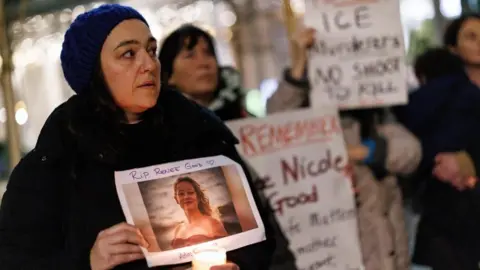
US investigators will face a host of thorny questions in determining whether the fatal shooting of a woman by a federal agent in Minneapolis last week was justified, as local and national officials recount drastically different accounts of an incident that sparked nationwide protests.
Several videos have emerged showing US Immigration and Customs Enforcement (ICE) agent Jonathan Ross firing at and killing Renee Good, 37, while she was behind the wheel of her burgundy Honda in a residential neighbourhood of the northern city.
President Donald Trump and his administration have described Good as a 'domestic terrorist' who was trying to run over the ICE agent, while state officials have said Good, a mother of three, was trying to leave the scene.
Former law enforcement officials told the BBC that a review of the incident could plausibly find the agent was justified in using deadly force because he believed Good was a threat.
But they said Trump officials' strong public statements in support of Ross in the immediate aftermath of the shooting could complicate the investigation.
Local and federal officials have both cited video footage of the incident to support their interpretations of the event.
Multiple angles show ICE agents approaching a car in the middle of the street and asking the driver - Good - to get out. One of the agents then tugs at the driver's side door handle. As the vehicle begins to move forward, an agent stood in front of the car - Ross, who was also filming - points and shoots at Good. The car turns away from the officers and crashes on the side of the road.
Under DHS policy, agents are authorized to use deadly force if they believe they are at risk of death, imminent threat of death, or grievous bodily harm. A specific clause states that officers cannot fire at a moving vehicle unless someone in the car is threatening the officer or unless the vehicle is 'operated in a manner that threatens to cause death or serious physical injury.'
Investigators will also reconstruct the scene physically and digitally and will examine other evidence, including witness accounts, which can influence the investigation's outcome.
This case, which involves a federal officer, falls under the jurisdiction of the federal government, raising concerns from local officials who feel excluded from the investigation process.
Despite differing accounts, the case has opened dialogues on policing practices and the political implications of law enforcement actions.
}