In brief
2026 marks a crucial year for Aditya-L1, India's solar observation mission, as it will monitor the Sun's maximum activity. With solar storms expected to increase significantly, the mission aims to enhance understanding and forecasting of coronal mass ejections (CMEs), which could impact Earth's technology and infrastructure.
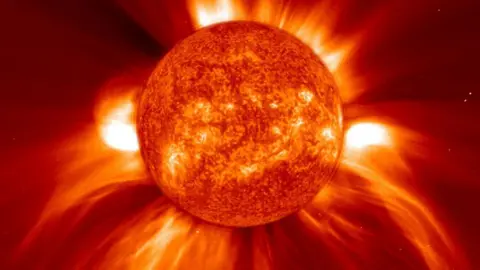
For Aditya-L1, India's first solar observation mission in space, the year 2026 is expected to be like no other. It's the first time the observatory – which was placed in orbit last year - will be able to watch the Sun when it reaches its maximum activity cycle. According to Nasa, it comes roughly every 11 years when the Sun's magnetic poles flip, leading to substantial solar activity. During this time, solar storms and coronal mass ejections (CMEs) become more frequent and intense.Comprised of charged particles, a CME can weigh up to a trillion kilograms, traveling at speeds of up to 3,000 km/s. It is estimated that while normal solar activities produce two to three CMEs daily, 2026 will see that number rise to ten or more. Prof R Ramesh of the Indian Institute of Astrophysics, principal investigator on the mission, emphasizes the significance of studying these CMEs, noting their role in understanding the Sun and potential threats to Earth.CMEs, while rarely posing direct threats to life, can disrupt satellites and power grids, affecting weather and communication technologies. Historically, powerful solar storms have caused significant disturbances, demonstrating the importance of proactive monitoring. Aditya-L1 is designed to provide invaluable data, enabling the prediction of solar events and the implementation of protective measures for Earth’s infrastructure.With its unique instrumentation, Aditya-L1 stands out among solar missions, allowing continuous observation of the Sun’s corona, crucial for forecasting solar storms. As preparations for the peak solar cycle intensify, the mission aims to enhance readiness for potential disruptions caused by increased solar activity in 2026.