In brief
A catastrophic rail disaster in Spain, which claimed 45 lives, was triggered by a track fracture discovered before a high-speed train's journey. The initial report indicates that significant gaps in the track were noted, affecting train stability and leading to the collision of multiple trains. The CIAF's preliminary findings have sparked further investigations into the track's condition and the safety protocols involved in rail management.
A fracture in a straight section of track occurred prior to the passage of a high-speed train that derailed, causing last Sunday's rail disaster in which 45 people died, according to an initial report.
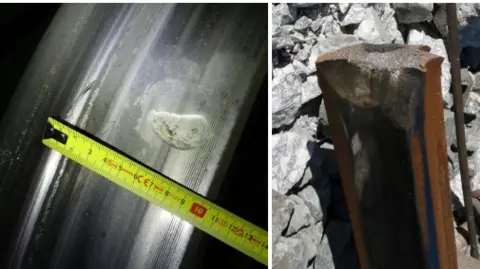
The train run by private company Iryo derailed last Sunday, with its rear carriages crossing onto an opposite track into the path of an oncoming state-owned Renfe train. The CIAF rail investigation commission reported that the Iryo train's front carriages showed 'notches' in their wheels, as did three earlier trains that traversed the same track.
Investigators are closely examining a significant gap of nearly 40cm (15 inches) in the track that’s now a focal point in understanding the crash.
The deadly collision took place at around 19:45 local time (18:45 GMT) shortly after the Iryo train set off from Málaga toward Madrid. The rear carriages—six to eight—derailed and collided with the Renfe train. The preliminary report highlighted that carriage six derailed due to 'a complete lack of continuity in the track.'
Most fatalities occurred in the front carriages of the Renfe train. Transport Minister Óscar Puente confirmed that grooves on the Iryo train's wheels were compatible with the existence of track fractures, noting that three trains that had passed earlier showed similar patterns.
The CIAF deemed its report a 'working hypothesis,' pending further detailed analysis. They stated that if the fracture was indeed the cause, it must have happened in the moments leading up to the derailment, implying it would have been difficult to detect.
This accident marks Spain's worst rail disaster in over a decade. The last major incident occurred in 2013, resulting in 80 fatalities during a high-speed train derailment in Galicia.