In brief
As the U.S. fortifies its defenses, questions arise about feasibility, costs, and global implications.
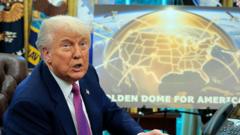
In recent discourse, President Donald Trump has engaged the nation by unveiling his visionary project, the "Golden Dome." Its objective is to revolutionize America's missile defense architecture in light of increasingly advanced threats from global adversaries. The initiative is underpinned by fears of futuristic warfare scenarios where aerial nuclear attacks and electromagnetic pulses could wreak havoc across the country. Experts like authors and defense researchers, including William Fortschen, emphasize the dire consequences of a nuclear detonation above American soil, which could render critical infrastructure non-functional. In response to such threats, Trump has proposed the Golden Dome, intended to function as a next-generation missile shield. However, this ambitious plan is not without hurdles. Financial analysts and missile defense experts underline the significant logistical challenges and staggering costs associated with implementing such a system. Early projections suggest a budget exceeding $542 billion over two decades just for space-based components of the defense network, starkly contrasted with Trump's initial estimates of $175 billion, including a $25 billion upfront commitment.The concept was first introduced during Trump's address to Congress, where he pointed to Israel's Iron Dome as a model. While the Iron Dome has successfully intercepted short-range threats, the proposed Golden Dome aims to contend with long-range missiles, hypersonics, and other advanced weaponry—effective integration of multiple defense layers remains a core concern highlighted by experts in the field.Still, some assert that the prospect of such a defense could alter geopolitical dynamics. The advancement of the Golden Dome could deter potential attacks by compelling adversaries to recalibrate their military strategies. It raises important questions about future arms races, particularly concerning reactions from nations such as China, who have already signaled concerns regarding the international implications of enhanced U.S. defenses.In conclusion, as the concept of the Golden Dome evolves, the dialogue continues, centered around its viability against an ever-changing global security landscape. The journey to establishing an effective missile defense strategy is fraught with monumental risks and uncertainties, yet many confidently affirm the necessity of such a system for national safety.