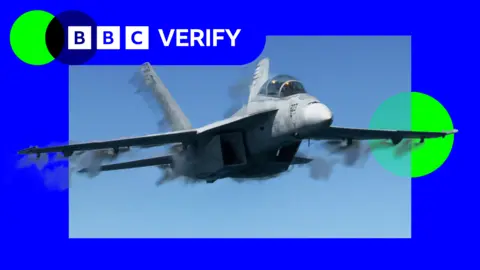
Two US fighter jets were tracked circling the Gulf of Venezuela on Tuesday as tensions continue to escalate between the two countries. The F/A-18 Super Hornets appeared on flight tracking sites near Maracaibo, Venezuela's second-largest city, at around 13:00 (17:00 GMT), before circling the gulf for about 40 minutes. A US defence official told the Associated Press the F/A-18 jets had conducted a routine training flight in the area.
The incident comes amid a wave of US strikes against boats in the Caribbean Sea, which the White House said were trafficking drugs to the US from Venezuela. Experts have raised questions over the legality of the strikes, which have killed more than 80 people. Venezuelan President Nicolás Maduro has accused the US of using the strikes to destabilise the country and oust him from power.
In an interview conducted with Politico the day before the jets approached Venezuela's coastline, Trump declared that Maduro's days in power were numbered and declined to comment on whether US troops could be deployed to the country.
A separate jet, an EA-18G Growler, also appeared just before the F/A-18s on the tracking site FlightRadar24. Data shows the jet flew loops just north of Venezuela's coast. They are the latest in a number of unusual US air force activities that have been tracked since September. B-52 Stratofortress and B-1 Lancer bombers previously flew up to and along the Venezuelan coast.
However, the F/A-18s, capable of engaging targets both on the ground and in the air, appear to be the first to approach the Venezuelan coastline so publicly in recent months. The F/A-18s came within 20 nautical miles of the coastline, flight tracking data showed, but the US official stated that the jets remained in international airspace.
Neither the F/A-18s or the Growler showed a point of origin or a destination on FlightRadar24, and all three aircraft only turned on their transponders when they arrived near the Venezuelan coastline. Justin Crump, head of the risk consultancy Sibylline, suggested the move was intended to support the administration's signalling and put pressure on the [Venezuelan] leadership. The F/A-18s - which operated under the callsigns RHINO11 and RHINO12 - flew six loops up and down the Gulf of Venezuela, while the Growler jet - flying under the codename GRIZZLY2 - also flew circles along the coast.
Greg Bagwell, a former RAF air marshal and president of the Air and Space Power Association, told BBC Verify that the flights appeared to be probing Venezuelan defence and trying to check for responses such as radio traffic and encrypted signals related to defence systems. He added that the Growlers would have been listening for signals intelligence, while the Super Hornets would have provided air defence cover for the Growlers.
Crump further mentioned that the jets also had the capability to test jamming capabilities, which potentially signifies to Venezuela's leadership that their systems cannot be relied upon. The US has deployed troops, ships, and jets to the Caribbean in recent months, which officials assert is to combat drug trafficking in the area. On Tuesday, the US Southern Command published photos of an F/A-18 operating from the USS Gerald Ford, the world's largest aircraft carrier, which has been sent to the Caribbean.
Analysis of satellite images and ship tracking websites by BBC Verify indicates the identification of at least nine military vessels that have been deployed to the region over recent weeks. Additionally, satellite images reflect that an airbase in Puerto Rico, closed in 2004, has been re-activated, with upgrades to the runway and the deployment of advanced F-35 fighters.
The incident comes amid a wave of US strikes against boats in the Caribbean Sea, which the White House said were trafficking drugs to the US from Venezuela. Experts have raised questions over the legality of the strikes, which have killed more than 80 people. Venezuelan President Nicolás Maduro has accused the US of using the strikes to destabilise the country and oust him from power.
In an interview conducted with Politico the day before the jets approached Venezuela's coastline, Trump declared that Maduro's days in power were numbered and declined to comment on whether US troops could be deployed to the country.
A separate jet, an EA-18G Growler, also appeared just before the F/A-18s on the tracking site FlightRadar24. Data shows the jet flew loops just north of Venezuela's coast. They are the latest in a number of unusual US air force activities that have been tracked since September. B-52 Stratofortress and B-1 Lancer bombers previously flew up to and along the Venezuelan coast.
However, the F/A-18s, capable of engaging targets both on the ground and in the air, appear to be the first to approach the Venezuelan coastline so publicly in recent months. The F/A-18s came within 20 nautical miles of the coastline, flight tracking data showed, but the US official stated that the jets remained in international airspace.
Neither the F/A-18s or the Growler showed a point of origin or a destination on FlightRadar24, and all three aircraft only turned on their transponders when they arrived near the Venezuelan coastline. Justin Crump, head of the risk consultancy Sibylline, suggested the move was intended to support the administration's signalling and put pressure on the [Venezuelan] leadership. The F/A-18s - which operated under the callsigns RHINO11 and RHINO12 - flew six loops up and down the Gulf of Venezuela, while the Growler jet - flying under the codename GRIZZLY2 - also flew circles along the coast.
Greg Bagwell, a former RAF air marshal and president of the Air and Space Power Association, told BBC Verify that the flights appeared to be probing Venezuelan defence and trying to check for responses such as radio traffic and encrypted signals related to defence systems. He added that the Growlers would have been listening for signals intelligence, while the Super Hornets would have provided air defence cover for the Growlers.
Crump further mentioned that the jets also had the capability to test jamming capabilities, which potentially signifies to Venezuela's leadership that their systems cannot be relied upon. The US has deployed troops, ships, and jets to the Caribbean in recent months, which officials assert is to combat drug trafficking in the area. On Tuesday, the US Southern Command published photos of an F/A-18 operating from the USS Gerald Ford, the world's largest aircraft carrier, which has been sent to the Caribbean.
Analysis of satellite images and ship tracking websites by BBC Verify indicates the identification of at least nine military vessels that have been deployed to the region over recent weeks. Additionally, satellite images reflect that an airbase in Puerto Rico, closed in 2004, has been re-activated, with upgrades to the runway and the deployment of advanced F-35 fighters.