In brief
The Tapanuli orangutans, the world's rarest ape species, are missing after massive floods ravaged their habitat in North Sumatra due to Cyclone Senyar. Conservationists worry that the endangered primates may have been swept away or unable to escape the natural disaster. A carcass believed to be an orangutan has been discovered, intensifying concerns about the survival of this critically endangered population, which numbers less than 800 individuals. The cyclone's destruction of their forested habitat poses a dire threat to the species' existence.
An unusual silence in the forests of north Sumatra in Indonesia is worrying wildlife experts and conservationists.
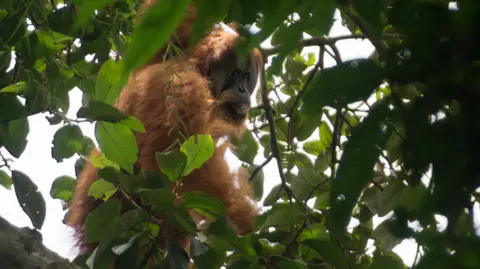
Here, in the mountainous forests of Batang Toru, is where they had always seen and heard the world's rarest ape, the Tapanuli orangutans.
But ever since Cyclone Senyar devastated Sumatra on 25 November, the critically endangered primates have not been seen in the area, conservation workers say.
Their absence has fuelled speculation as to whether the great apes were swept away by floods and landslides. And while some believe the animals may have travelled to a safer location, a carcass found in the area, said to be that of an orangutan, is fuelling conservationists' fears.
Fewer than 800 Tapanuli orangutans remain and any loss would have a serious impact on the species, conservationists say.
Humanitarian workers told the BBC they found the dead animal semi-buried in the debris of mud and logs in Pulo Pakkat village in central Tapanuli district earlier this week.
When I first saw it I was not sure what it was, because it was kind of defaced, perhaps because it was buried underneath by the sludge and logs, said Deckey Chandra, who has been working with a humanitarian team in the area. He previously worked in the conservation of the Tapanuli orangutans.
I have seen several dead bodies of humans in the past few days but this was the first dead wildlife, he said. They used to come to this place to eat fruits. But now it seems to have become their graveyard.
More than 900 people have died as a result of heavy rain, floods and landslides since Cyclone Senyar ravaged parts of Indonesia in late November. Hundreds are still missing, with many villages in Sumatra completely destroyed as the storm swept across the island.
Professor Erik Meijaard, managing director of Borneo Futures in Brunei, is now studying the disaster's impact on the orangutans with the help of satellite images.
He said 4,800 hectares (11,860 acres) of forest on the mountain slopes can be seen as destroyed by landslides - but since part of the satellite image is cloud covered, he's extrapolated the destruction figure to 7,200 hectares in his preliminary observation.
The destroyed areas would have contained some 35 orangutans, and considering the violence of the destruction it wouldn't surprise us if they are all dead. That's a major blow to the population, he told the BBC.
Featuring photographs of the carcass, Mr. Chandra noted that the grim state of the animal raised serious questions regarding the fate of the Tapanuli orangutan population, which was only identified as a distinct species in 2017.
Latest reports highlight the enormous environmental damage caused by Cyclone Senyar, prompting increased concerns about wildlife conservation in the area.