In brief
The article delves into the historical evolution of Bombay, now known as Mumbai, highlighting the city's transition from seven islands to a thriving urban center. A new exhibition titled 'Bombay Framed' captures this rich narrative through paintings, photographs, and multimedia, presenting diverse perspectives from elite merchant class to everyday lives. Curator Gyan Prakash emphasizes that the city embodies many experiences, making it a living artwork shaped by its inhabitants. The article also reflects on key historical moments that defined the city’s architectural and cultural landscape.
From seven islands to a city of 20 million, Bombay (now Mumbai) has been shaped over centuries by political, economic, and social forces.
From Koli fisherfolk to colonial planners, Bollywood stars to textile barons, many have influenced the landscape and identity of this vibrant western Indian city.
With a history of constant evolution, the city has transitioned from fishing nets to bustling ports, mills, and now, modern malls, continually reinventing itself.
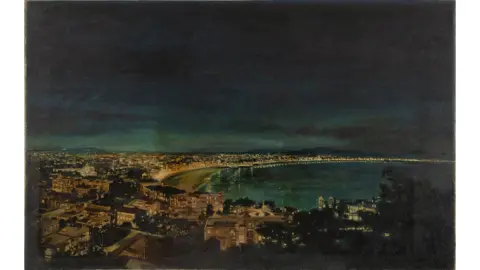
A new exhibition titled 'Bombay Framed' takes visitors through this shape-shifting journey, featuring an array of paintings, photographs, and multimedia displays.
Spanning over 100 images across three centuries, the exhibition documents the city’s diverse heritage, showcasing everything from the elite lifestyles of Zoroastrian merchants and iconic cinema stars to the daily struggles of ordinary citizens.
According to curator Gyan Prakash, the exhibition invites viewers to see the city as a complex artwork made up of manifold experiences, reflecting its rich tapestry.
Key moments in the city's transformation occurred during the 1830s and 40s when reclamations joined the seven islets into one island city, followed by the removal of fort walls in the 1860s that ushered in its colonial character.
In the 1920s and 30s, the Art Deco Marine Drive corniche was constructed, introducing a modern architectural style distinct from its Victorian Gothic heritage.
Today, the city is undergoing a further transformation, with practical infrastructures like sea bridges and coastal roads re-defining its landscape.
Beneath this architectural evolution lies the spirit of its citizens—past and present. The exhibition reflects this narrative, combining historical art with portraits of marginalised communities, Parsi elites, and the intertwined existence of luxury alongside poverty.
Notably, the city's evolution is encapsulated in its changing name from Bombay to Mumbai, a decision made in the 1990s to distance itself from colonialism. Prakash explains the title 'Bombay Framed' pays homage to the city's historical significance during that era, as many images were created when it was still called Bombay.
This rich exploration of Bombay’s transformation is not just about visual aesthetics but also the diverse stories that contribute to its identity, making it a truly unique metropolitan experience.