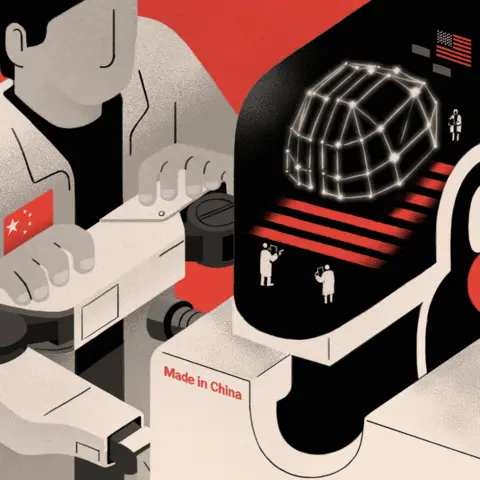
AI Showdown: China and the US Compete for Dominance
In the second half of the 20th Century, it was the race to develop nuclear arms that occupied some of the finest minds in the US and the Soviet Union. Now, the US finds itself in a different kind of race with a different adversary: China. The aim is to dominate technology; specifically Artificial Intelligence (AI).
This competition occurs in research labs, university campuses, and cutting-edge start-ups, closely watched by leaders of some of the world's wealthiest companies and at the highest levels of government. It costs trillions of US dollars, and both sides have their strengths.
Nick Wright, a cognitive neuroscience expert, describes this rivalry as a battle between brains and bodies. The US has traditionally excelled in developing AI brains—chatbots, microchips, and large language models (LLMs)—whereas China has superior expertise in producing AI bodies, especially humanoid robots.
The Battle for LLM Dominance
On November 30, 2022, California-based OpenAI launched ChatGPT, a groundbreaking chatbot that took the tech world by storm. This marked the emergence of the first mainstream large language model, capable of analyzing vast quantities of data and learning patterns in expression.
Experts largely agree that the US currently holds the advantage in AI brains, with OpenAI claiming over 900 million users weekly for ChatGPT. American tech companies like Anthropic and Google are racing to produce rival LLM systems, with vast financial investments, anticipating that the right technology will significantly alter the future of work.
How the Americans Played Their Chips
Nonetheless, Washington is also focused on the implications of its technological race with China for global dominance. A senior US official emphasized that America's advantage lies not just in algorithmic development, but significantly in the hardware underpinning their operation, particularly microchips.
The US controls the world's high-end chips essential for AI, designed mainly by Nvidia. This year, under President Biden, export controls tightened to prevent China from acquiring these materials. Interestingly, while the chips are mostly produced in Taiwan, they are subject to US oversight.
The DeepSeek Counter-Attack
In January 2025, just as Donald Trump assumed the presidency for a second time, China launched its AI chatbot called DeepSeek, which performs comparably to US LLMs but at a significantly lower cost. This prompted a dramatic stock market reaction, resulting in Nvidia suffering a formidable single-day market loss of $600 billion.
Critics noted that America's strict export controls may have inadvertently accelerated China's self-reliance in AI. DeepSeek's development highlighted a crucial difference in tech culture: American firms frequently protect their intellectual property, while Chinese enterprises adopt a more open-source philosophy that encourages collaborative innovation.
Who's Winning the Robot Wars?
In AI bodies, China has historically excelled. Beyond investing heavily in robotics to operationalize its manufacturing strengths, China now boasts more working robots than the rest of the world combined. Notably, it dominates humanoid robot exports as it develops machines intended to fill gaps in care work due to its aging populace.
Both nations are increasingly combining AI and robotics technologies. Boston Dynamics, a prominent US robotics firm, has developed robots like Spot, capable of executing complex tasks with advanced AI integration, which finds applications in various sectors—including potential military deployments.
Who Will Triumph?
Predicting a winner in this AI race is challenging, particularly given the absence of a visible finish line. Success may not be defined by singular milestones but by sustained advantages in AI capability, effective economic integration, and the ability to set global standards.
As the contrasts in their approaches unfold, with US companies favoring proprietary technologies and China promoting open innovation, the AI rivalry continues to shape the future. The stakes are high, as this battle could determine which nation emerges as the dominant global power in the coming century.