In brief
Hussain’s contributions to music transcended borders, earning him global acclaim and inspiring countless artists in his wake.
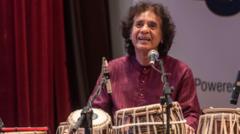
Zakir Hussain, one of the most celebrated tabla players globally, has died at the age of 73 due to idiopathic pulmonary fibrosis, a severe lung condition. His family confirmed the news, stating that Hussain passed away at a hospital in San Francisco. He was not just a musician but a cultural ambassador, earning four Grammy awards and being the recipient of the Padma Vibhushan, which is India’s second-highest civilian honor.The tabla, usually seen as a supportive instrument in Indian classical music, gained prominence as a solo entity through Hussain’s groundbreaking performances, captivating audiences worldwide. As news of his passing spread, tributes emerged from across the globe. Sitar and tabla player Nayan Ghosh expressed his deep sorrow, noting that Hussain was a transformative figure who elevated Indian music's status globally. English guitarist John McLaughlin lauded him, stating that Hussain turned rhythm into magic, while Grammy-winning composer Ricky Kej described him as one of India's most extraordinary musical talents. Indian Prime Minister Narendra Modi acknowledged Hussain as a genius who altered the classical music landscape, with comments from various leaders and international figures reiterating his irreplaceable contributions.Hussain was born in Mumbai in 1951, steeped in a musical background from an early age under the guidance of his father, Ustad Allarakha Khan. He performed alongside his father by the age of seven, subsequently collaborating with numerous musical legends. By 19, he had established a worldwide presence with over 150 performances annually. His album, "Planet Drum," co-created with drummer Mickey Hart, won a Grammy in the inaugural category of Best World Music Album, propelling him to international stardom. Over his prolific career, Hussain received seven Grammy nominations and won four awards. He was known for his humility, attributing his success to the appeal of music itself rather than his own talents.In his later years, Hussain focused on supporting emerging artists, playing primarily with younger musicians and fostering a new generation of talent. His unparalleled ability to connect with audiences played a pivotal role in raising the stakes for ticket prices in classical music events, enhancing the cultural landscape.Despite his passing, Hussain's legacy as an innovative, boundary-pushing artist remains alive, inspiring future musicians in the realm of Indian classical music and beyond. His influence will be remembered, as he dedicated his life to sharing his reverence for the art.