In brief
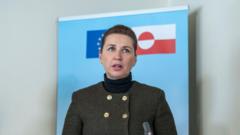
As tensions rise over US President Donald Trump's threats to acquire Greenland, Danish Prime Minister Mette Frederiksen and her government respond with caution, emphasizing the need for Greenlanders to determine their own future while maintaining diplomatic relations with the US.
In a chilling January for Denmark's political landscape, Prime Minister Mette Frederiksen is faced with the fallout from President Donald Trump's recent comments suggesting the acquisition of Greenland. The gloomy weather in Copenhagen reflects the mood of the nation's leaders who take Trump's threats seriously, as articulated by Foreign Minister Lars Løkke Rasmussen. Despite the gravity of the situation, he emphasized a desire to avoid escalating "a war of words."Prime Minister Frederiksen attempted to downplay Trump's military threats, stating on Danish television, "I don't have the fantasy to imagine that it'll ever get to that." Echoing this sentiment, Lars Sandahl Sorensen, CEO of Danish Industry, reassured that there is "no interest in a trade war." However, urgency has permeated the Danish political scene, leading to swift high-level discussions in response to the surprising remarks.Greenland's Prime Minister Mute B. Egede visited Copenhagen this week for meetings with Frederiksen and King Frederik X, highlighting the seriousness of the situation. In an extraordinary political gathering, party leaders convened in the parliament to address this "provocation" by Trump. Frederiksen maintained a conciliatory tone, dubbing the U.S. "Denmark's closest partner," while reiterating that decisions regarding Greenland are ultimately for its people to determine.The delicate balance of diplomacy is evident as Frederiksen seeks to avoid aggravating tensions. In the past, she criticized Trump's purchase proposal, which led to the cancellation of a planned state visit. Observers believe that Denmark is navigating a complex new geopolitical landscape as Greenland harbors growing aspirations for independence, fueled by its own parliament and a push against colonial legacies.Critics have suggested that Frederiksen's response lacked the firmness needed to reject any notion of U.S. dominance. Opposition MP Rasmus Jarlov described Trump's behavior as unprecedented disrespect, arguing that Denmark should assertively defend Greenland's autonomy.The situation is complicated; although Greenland benefits from support through Denmark, its own socio-political identity is evolving, particularly among younger generations advocating for independence. There's speculation that a referendum might follow, which could reshape Denmark's economic ties, given that roughly 60% of Greenland’s economy relies on the Danish government.The possibility of an independent Greenland poses new challenges, as it would have to weigh the benefits of sovereignty against economic viability. As politicians within Denmark ponder the ramifications of Trump's views, EU leaders echo concerns about international norms regarding national integrity. The strong responses from German Chancellor Olaf Scholz and French Foreign Minister Jean-Noël Barrot suggest that Trump's behavior raises alarms beyond Denmark.The prospect of Trump's military intervention further clouds the air, generating considerable anxiety within Denmark's trade sector. A study indicated that 10% tariffs imposed by the US could severely impact Denmark's GDP.As Trump prepares to assume office, Danish leaders brace for the unknown, with hopes that his focus might shift toward other EU nations. Nevertheless, uncertainty prevails regarding the Greenland issue, as the potential reality of a bolder, unrestrained geopolitical stage looms large over Denmark and its relationship with the U.S.