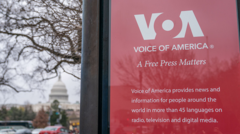
Trump has signed an executive order that significantly reduces funding for the Voice of America (VOA), a federally funded media organization established to counteract propaganda from enemies of the United States since World War II. The order affects VOA's parent organization, the US Agency for Global Media (USAGM), which oversees other entities including Radio Free Europe and Radio Free Asia. Affected agencies have been instructed to minimize their operations to what's strictly necessary.
In an alarming development for VOAs 1,300 employees, director Mike Abramowitz announced that virtually the entire staff has been placed on paid leave. He expressed that the executive order severely impairs VOA’s crucial mission to present accurate narratives when faced with competing propaganda from nations such as Russia, China, and Iran.
Communication from the Trump administration has been sparse, and the overall fate of the stations is still uncertain. Reports indicate that freelance workers and international contractors have been informed that funds for their pay have been halted. Federal grants for Radio Free Asia and Radio Free Europe/Radio Liberty have also been reportedly terminated.
With a global audience of over 400 million listeners, VOA serves a role akin to that of the BBC World Service, fostering a critical dialogue on democratic values and informative news. Notably, criticism of the organization from Trump isn’t new, as he publicly denounced VOA during his first presidency, asserting that mainstream media are biased against him.
Noteworthy figures like Elon Musk, who serves as an unofficial adviser, have called for the closure of VOA on social media, adding to the strain on the organization. Trump's recent appointments of loyalists to key positions in USAGM only further indicate a potential shift towards more government control over independent media sectors.
With a history dating back to its first broadcast in 1942, VOA has navigated challenges to its editorial independence, a mandate reinforced by former President Gerald Ford's charter in 1976. The current executive order and its implications for American journalism and global perceptions of the U.S. continue to raise significant concerns among advocates of free press.
In an alarming development for VOAs 1,300 employees, director Mike Abramowitz announced that virtually the entire staff has been placed on paid leave. He expressed that the executive order severely impairs VOA’s crucial mission to present accurate narratives when faced with competing propaganda from nations such as Russia, China, and Iran.
Communication from the Trump administration has been sparse, and the overall fate of the stations is still uncertain. Reports indicate that freelance workers and international contractors have been informed that funds for their pay have been halted. Federal grants for Radio Free Asia and Radio Free Europe/Radio Liberty have also been reportedly terminated.
With a global audience of over 400 million listeners, VOA serves a role akin to that of the BBC World Service, fostering a critical dialogue on democratic values and informative news. Notably, criticism of the organization from Trump isn’t new, as he publicly denounced VOA during his first presidency, asserting that mainstream media are biased against him.
Noteworthy figures like Elon Musk, who serves as an unofficial adviser, have called for the closure of VOA on social media, adding to the strain on the organization. Trump's recent appointments of loyalists to key positions in USAGM only further indicate a potential shift towards more government control over independent media sectors.
With a history dating back to its first broadcast in 1942, VOA has navigated challenges to its editorial independence, a mandate reinforced by former President Gerald Ford's charter in 1976. The current executive order and its implications for American journalism and global perceptions of the U.S. continue to raise significant concerns among advocates of free press.