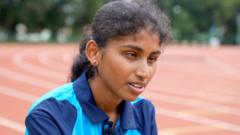
"When I was growing up, everyone in my village would say: 'She is blind, she is a waste,'" reflects Rakshitha Raju, now a renowned middle-distance para athlete at just 24 years old. Hailing from a humble background in a remote southern Indian village, Rakshitha lost both parents by age 10 and was raised by her understanding, hearing and speech-impaired grandmother.
At age 13, encouragement from her sports teacher revealed her potential as a great athlete, despite her visual impairment. Guided with a tether alongside her running partner, Rakshitha discovered her passion for athletics. After competing in the National Games, she caught the attention of Rahul Balakrishna, a middle-distance runner and her mentor ever since.
Together for eight years, Rakshitha and Rahul proved their prowess on the world stage, winning gold at the 2018 and 2023 Asian Games. Their partnership deepened as Rakshitha learned to trust Rahul completely. Her emotional testimony, "I believe in my guide runner more than myself," showcases their bond.
Competing with Rahul, Rakshitha made history as the first blind Indian woman in the 1500m at the Paralympics in Paris 2024. Though they finished without a medal, their impact resonated widely, earning a raucous welcome back home.
Meanwhile, another inspiring story unfolds with Simran Sharma, who became India's only other visually impaired female athlete to qualify for Paris. Challenges arose when she needed a guide runner, eventually finding Abhay Kumar who is helping her navigate the hurdles of competition while he aims to develop his own career.
Their partnership faced initial hurdles, including a disqualification due to misunderstanding race rules, but they rallied to claim gold in the 200m at the World Para Athletics Championships. Simran made history as the first Indian woman with visual impairment to win a medal at the Paralympics, securing bronze in the 200m event.
Yet, both athletes raise crucial concerns about their guides' future, as current policies do not provide sufficient support or career paths for them. Despite limited financial backing, both Rakshitha and Simran now benefit from sponsorships, which aid their training and allow them to compensate their guides.
Looking ahead, Simran aims to change the color of her medal while Rakshitha dreams of achieving her own podium success. "She must win a medal," urges Rahul, as they dream of becoming role models for many aspiring athletes in similar circumstances.
Amid ongoing struggles, the encouraging narratives of these remarkable women spotlight the fight for equality and recognition in sports as the Indian Sportswoman Of The Year (ISWOTY) Award prepares to honor women athletes' achievements.