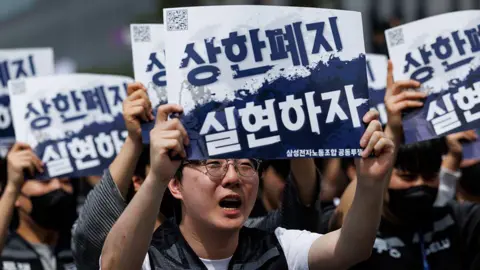
In a landmark ruling, South Korea's Supreme Court has officially absolved Samsung's leader, Lee Jae-yong, of fraud charges stemming from a disputed 2015 merger. Lee, who has been navigating the complexities of the law since 2017, faced allegations of misrepresenting financial figures to secure control over Samsung's future and influence succession plans within the conglomerate.
The verdict marks the end of a protracted legal saga that scrutinized the corporate ethics of Samsung, a powerful family-run conglomerate in South Korea. "The Supreme Court’s decision confirms the lawful nature of the merger involving Samsung C&T and the accounting practices of Samsung Biologics," remarked Lee’s legal team in a statement following the ruling.
The allegations against Lee claimed he and his advisors inflated Samsung Biologics' valuation, aiding his acquisition of a significant stake in another Samsung subsidiary during the 2015 merger. This merger was widely viewed as part of the larger strategy to transition control from his father, Lee Kun-hee, who encountered his own legal issues before his passing in 2020.
Lee's legal troubles began when he was implicated in a bribery scandal linked to former President Park Geun-hye, leading to his arrest in 2017. Over the years, he has undergone several legal proceedings, including receiving a special presidential pardon during parole to support economic recovery in South Korea amid the COVID-19 pandemic.
In a decisive 2024 ruling, a district court dismissed most charges related to the $8 billion merger when prosecutors sought further challenges after previous acquittals. This ongoing legal battle has coincided with Samsung's struggle against market pressures, including dwindling smartphone sales and potential tariffs under US trade policies.
Industry players have welcomed the ruling, predicting it will instill quick decision-making within Samsung's leadership, enabling the company to better navigate impending trade challenges. The Federation of Korean Industries noted the importance of stability at the top of South Korea's largest corporation in these turbulent economic times.