In brief
With a growing desire to position itself as a year-round tourist destination, Zagreb's Christmas market, known as Zagreb Advent, has gained international attention. Despite its relatively young history, Zagreb Advent has evolved into a multi-venue event showcasing unique themes and local delicacies, striving to compete with established European Christmas markets.
Christmas markets are not just tradition across Europe, they are big businesses that give cities a huge economic boost every December. For Zagreb, the capital of Croatia, it is an effective way of attracting tourists outside of the country's main summer season.
The words tourism and Croatia are likely to conjure visions of sparkling Adriatic vistas during the hottest months of the year. Tourism accounts for more than a fifth of the economy of this Balkan country, and it is keen to encourage more visitors to arrive outside of the height of summer. Yuletide frolics are a key part of that strategy.
We're making a transformation, says Croatia's Tourism Minister, Tonci Glavina. We are developing as a year-round tourism destination – we are not a summer destination anymore. Croatia has really made a significant development. At some point way back it was just sun and sea, but now Croatia offers many tourism products all across the country.
Zagreb Advent, as the capital's Christmas markets and events are collectively known, is the poster child for this approach, with billboards in neighbouring countries urging people to attend. In fact, this year the campaign has spread as far as London's tube stations and Milan's buses. There are even special trains to bring visitors from Slovenia and Hungary. All of it is part of Zagreb's push, in a very crowded field, to become one of Europe's most popular Christmas markets.
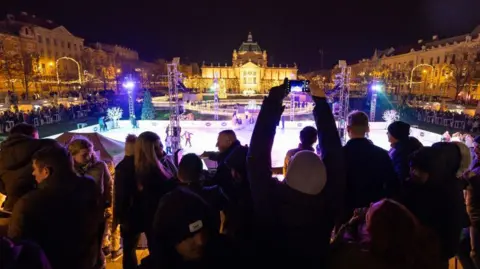
While some cities might limit their offering to a single location, Zagreb Advent is a multi-venue spectacular that takes over large chunks of the centre. The entire city has become a festive ground for celebrating Christmas throughout the whole of December, says Slavica Olujic Klapcic, who manages one of the Christmas market areas.
What's really special around here is that each of the locations has its own theme, and it's a little bit different in decoration, and in the content that it offers. So for a visitor, I think it's a good deal, because by taking a walk through Zagreb, you can see many different spots.
Like other Christmas markets across Europe there are no shortages of the usual seasonal staples, such as sausages and mulled wine. But there are also multiple music stages, craft stalls, vendors offering traditional Croatian food, art installations, and an enormous ice rink.
But Zrinka Farina, who is involved with putting on Christmas market events outside the city's historic Hotel Esplanade, insists that Croatians are serious about winning the title of Europe's best Christmas market. We are such a sporty nation, we love to compete – and when we do something, we really want to be the best in the world in it.
Such has been the effort that the city has put into Zagreb Advent since it was first held in 2014 that it was voted the best Christmas market in Europe for three years in a row, from 2015 to 2017.
The competition is organised by travel website European Best Destinations, and Zagreb's success has helped to drive visitor numbers to the city every December. Back in 2014, the city saw 100,198 people stay for at least one night during the last month of the year. By 2024 this had more than doubled to 245,352, which the tourist board says gave the city a €100m ($117m; £88m) economic boost.
However, Zagreb has a long way to go if it wishes to catch up with Europe's Christmas market heavyweights. The one held in the German city of Cologne is widely reported to be the most popular. It is expected to attract four million visitors this year, with an economic impact of €229m.
Meanwhile, Austria's capital Vienna attracts around two point eight million visitors to its Christmas market, and France's Strasbourg gets two million people. Zagreb's event is still relatively young – it is only in its 11th year when compared to the historical depth of markets like Dresden's, which first began in 1434.
Despite its infancy, Zagreb Advent is said to be attracting visitors from across Europe. They come here from Italy, Spain, Bosnia, Slovenia and even the UK, says Lucija Vrkljan, who is working as a steward at the ice rink.
Tourism Minister Tonci Glavina insists that Croatia is making moves in the right direction, noting that visitor numbers over July and August were slightly down but still on course for a record-breaking year thanks to significant growth either side of the summer peak.