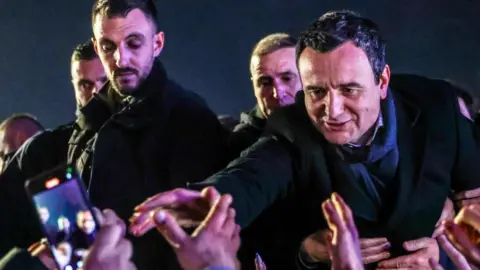
The Albanian nationalist Vetevendosje party has won a landslide victory in Kosovo's parliamentary elections, according to preliminary results.
With 90% of the votes counted, the party, whose name means self determination, stands at 50.8%, securing a third term for its leader, Albin Kurti.
The two primary oppositional parties, the centre-right Democratic Party of Kosovo (PDK) and the Democratic League of Kosovo (LDK), received 20.98% and 13.89%, respectively.
Vetevendosje previously won elections in February but without achieving a majority, which led to a government vacuum that persisted until now.
This electoral outcome raises a significant question for many: would the electorate penalize Kurti for the months of political stalemate in the National Assembly, or would they hold the opposition parties accountable for refusing a coalition?
The electorate's response seems clear. Although Kurti's party fell short of a governing majority, it should find support among MPs from ethnic minority parties, who hold a guaranteed 20 of the 120 seats in the National Assembly.
Vetevendosje's victory constitutes the fourth consecutive electoral success, vindicating Kurti after failed government formation negotiations post February’s elections.
Kurti emphasized the win as the greatest victory in the history of the country, expressing hope for cooperation from opposition parties rather than obstruction.
Arben Gashi from LDK alluded to this potential cooperation, stating, When voters speak, the result cannot be ignored. Reflection and responsible action are required, in a social media post.
This election carries significant implications. Kosovo has lost out on hundreds of millions in European Union funding due to a lack of a functioning government. Additionally, Kurti has indicated that agreements with the World Bank could elevate this figure to over €1 billion.
Reparations of ties with Kosovo's strongest international allies, the EU and the US, are also critical. Kurti has previously strained these relationships by targeting institutions serving Kosovo’s Serb minority, exacerbating tensions, particularly in the predominantly Serb northern Kosovo region.
While the EU has lifted punitive measures imposed in 2023, it now demands a pragmatic approach from Kurti in the long-stalled normalization talks with Serbia, a hope that may seem tenuous given Kurti's strained connections with Serbian President Aleksandar Vucic.
The strong endorsement for Kurti indicates a wary electorate, perhaps skeptical of alternative governance. The opposition, linked to the former Kosovo Liberation Army, has failed to deliver on promises of prosperity since declaring independence in 2008.
Analyst Artan Muhaxhiri noted numerous constitutional violations and economic failures under Vetevendosje's tenure. Nevertheless, he stated citizens perceive the opposition as a greater risk.
}