In brief
President Trump has signed an executive order reclassifying cannabis as a Schedule III substance, allowing for increased research opportunities and potentially easing regulations around its use. The move has sparked debate among lawmakers and advocates alike, with many praising the decision while others express concerns over normalizing cannabis consumption.
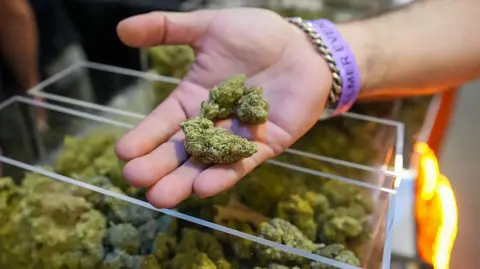
President Donald Trump has signed an executive order that will expand access to cannabis, a long-anticipated move that would mark the most significant shift in US drug policy in decades.
The order directs the US attorney general to reclassify cannabis from a Schedule I narcotic to a Schedule III drug - placing it under the same category as Tylenol with codeine.
Cannabis will remain illegal at the federal level. However, classifying it as a Schedule III narcotic would allow expanded research to ascertain its potential benefits.
Several Republican lawmakers have cautioned against the move, arguing it could normalize cannabis use.
The US Drug Enforcement Agency (DEA) notes that Schedule III narcotics, including ketamine and anabolic steroids, have only a moderate to low potential for physical and psychological dependence.
During the signing ceremony, Trump emphasized that people have been begging for the change, especially those suffering from conditions such as incurable pain, cancer, and veterans with service-related injuries.
In addition to reclassifying cannabis, Trump has ordered officials to collaborate with Congress to facilitate access to cannabidiol (CBD) for some Americans, with health officials tasked with exploring its health benefits and risks.
This order has garnered support from organizations advocating for cannabis reform, with Tim Barash, chairman of the Coalition of Cannabis Scheduling Reform, calling it a fundamental shift in perceptions towards the drug, bolstering the cannabis industry and its capacity to positively impact lives.
However, opposition remains strong among Republicans, as 22 Senators warned that marijuana use could hinder economic re-industrialization and pose health risks, suggesting no substantial scientific backing exists for the reclassification.
Public opinion generally favors cannabis legalization, with a recent Gallup poll showing 64% of Americans support it. Implementing this new classification may reflect an evolving attitude toward cannabis in society.