In brief
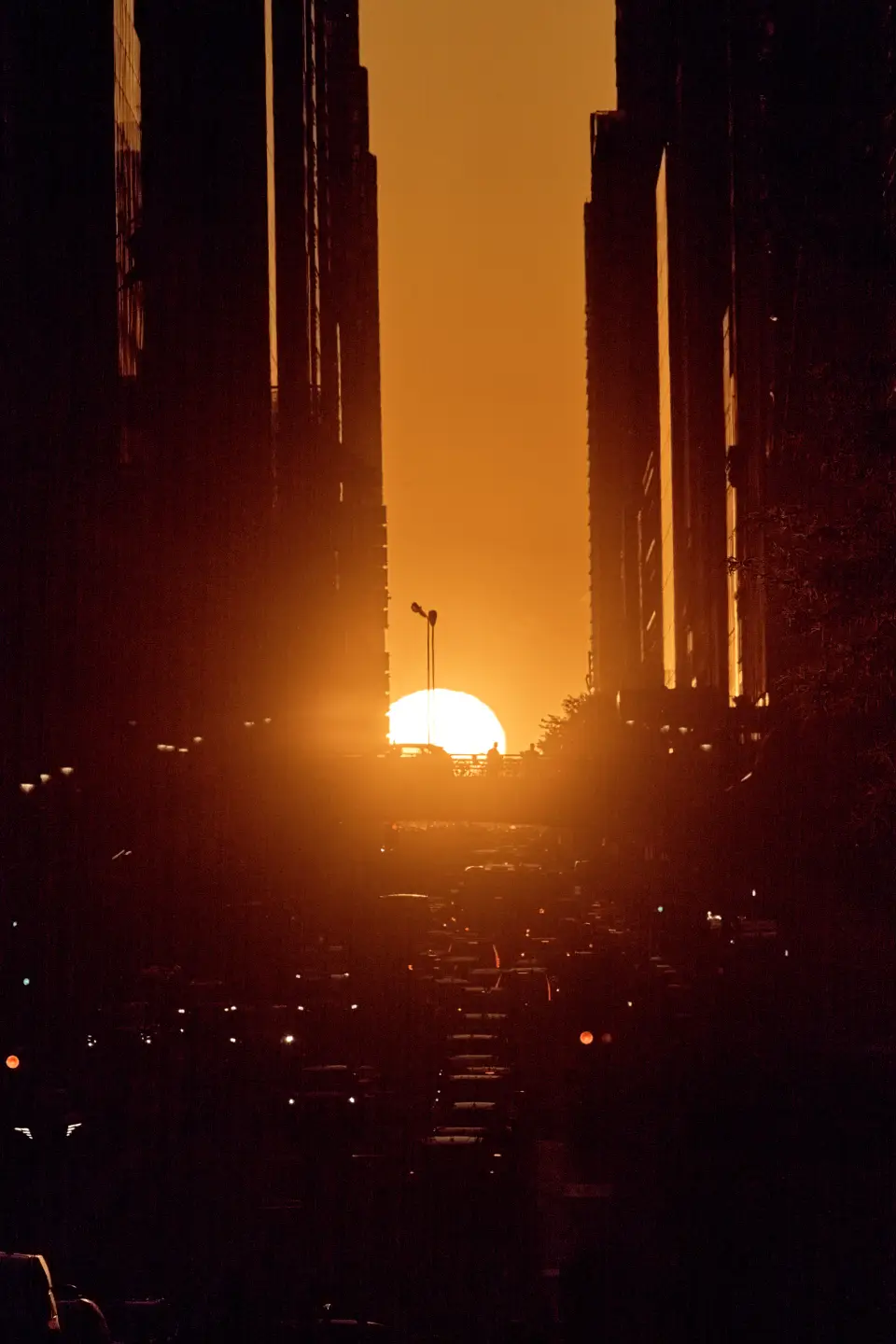
Manhattanhenge occurs when the setting sun aligns perfectly with the city's east‑west streets, creating a dramatic play of light between skyscrapers. The first split‑sun view happened Thursday, and the full‑sunrise will return on Friday. The phenomenon repeats on July 11 and 12, a few weeks before and after the June 21 solstice. Visitors typically gather along 14th through 57th Street, and nearby Queens, to capture the moment. Flat‑grid cities like Chicago and Baltimore also host similar sunset events, but Manhattanhenge remains unique for its towering buildings and clear view to the Hudson.
NEW YORK (AP) — In the heart of Manhattan, residents and visitors look up at the sky to experience a phenomenon that turns the city into a living art exhibit. The setting sun is framed by a canyon of skyscrapers, perfectly aligning with the island’s east‑west street grid on two evenings each year.The dramatic spectacle was first observed Thursday, when the sun was half above and half below the horizon as it edged down toward the Atlantic. That split‑sun effect is one of two versions of Manhattanhenge – the other seeing the entire corona of the sun hovering over the skyline. That full‑sun appearance will be witnessed again on Friday, before the sun sinks into the New Jersey horizon across the Hudson River.These reactions will repeat on July 11 and 12, occurring roughly three weeks before and after the summer solstice on June 21. Although the solstice itself isn’t a viewing day, the alignment of the sun with the street grid is most pronounced during this period.The name Manhattanhenge was coined in 1997 by astrophysicist Neil deGrasse Tyson, who compared Manhattan’s sun‑lit lines to the ancient Stonehenge observatory where the solstice sun greets the circle of lintels. While the original builders of Stonehenge intentionally aligned their stones to the sun, the planners of Manhattan’s grid never set out to do so – the alignment happened by chance.Typical viewing spots include 14th, 23rd, 34th, 42nd and 57th Streets – the city’s broad east‑west avenues. The farther east you go, the more dramatic the vista, as the sun strikes the facades on either side of the road. Even the Long Island City side of the East River offers a suitable view.Manhattanhenge is largely unorganized. Many people gather an hour before sunset to snap photos as dusk approaches. There is no crowd in the rain or on overcast days, so clear skies mean the highest turnout. Despite its lack of formal organization, Manhattanhenge remains a yearly tradition for New Yorkers and adventurers from around the globe.Other cities with grid layouts also experience similar sunset phenomena. Chicago has its own “Chicagohenge,” Baltimore offers “Baltimorehenge” on the March‑September equinox, and Toronto’s “Torontohenge” occurs in February and October. Manhattanhenge, however, stands out thanks to the height of its buildings and the unobstructed view to the Hudson.PulseWire’s live coverage of the event shows real‑time images shared on social media, user‑generated fact‑checking, and an interactive map that tracks the progress of the sun across the skyline. Don’t miss a chance to capture the city’s sky in its most cinematic alignment.\