In brief
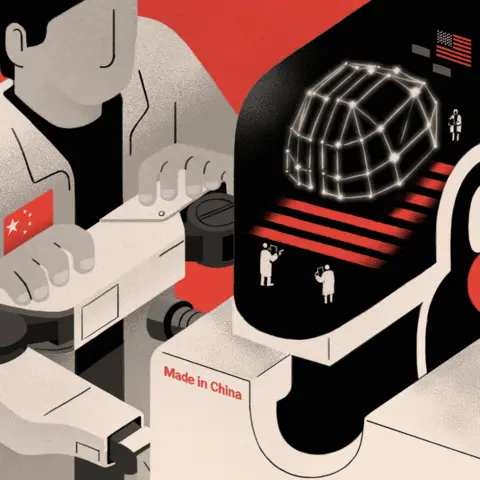
The competition between the US and China in the field of Artificial Intelligence (AI) is intensifying, with each country having its own strengths. The US excels in advanced AI brains, such as language models, driven by powerful computing hardware, while China invests heavily in robotics, creating highly efficient 'humanoid' robots. However, recent developments suggest that China is closing the gap in AI 'brains' with innovations like the DeepSeek AI chatbot, challenging the dominant position of American tech firms. This article explores the implications of this competition for global tech leadership and economic power.
In the second half of the 20th Century, it was the race to develop nuclear arms that occupied some of the finest minds in the US and the Soviet Union. Now the US finds itself in a different kind of race with a different adversary: China. The aim is to dominate technology; specifically Artificial Intelligence (AI). It's a fight taking place in research labs, on university campuses, and in the offices of cutting-edge start-ups - watched over by leaders of some of the world's richest companies and at the highest levels of government. It costs trillions of US dollars.And each side has its strengths - something Nick Wright, who works on cognitive neuroscience at University College London (UCL), neatly sums up as the battle between brains and bodies. The US has traditionally led on so-called AI brains: the world of chatbots, microchips, and large language models (LLMs). China has been superior on AI bodies: robots (and in particular, humanoid robots that look eerily like people). But now, with both sides anxious not to let their rival dominate, those advantages might not remain forever - and the race may yet be transformed further in the coming years.On 30 November 2022, the California-based tech firm, OpenAI, launched its new chatbot. In a six-sentence statement, the company announced they had trained a new model which interacts in a conversational way. It was called ChatGPT. Immediately, the tech world was dazzled. According to a senior US official, the strategic advantage lies less in the algorithmic coding, and more in the hardware driving the immense computing power, particularly microchips.America can flex its muscles on export controls, preventing China from acquiring powerful chips. However, in January 2025, China launched its own AI-powered chatbot, DeepSeek, similar in capability to American models but created at a fraction of the cost, surprising many in the tech world. With this, China demonstrated not only its ability to create competitive AI technologies but also the potential for closing the gap in the AI race.When it comes to robotics, particularly humanoid robots, China is well ahead, with significant government support and a thriving robotics industry that has led to vast numbers of robots in operational use. The competitive landscape is evolving as both nations strive to improve their capabilities in AI and robotics, raising questions about the future balance of global power.