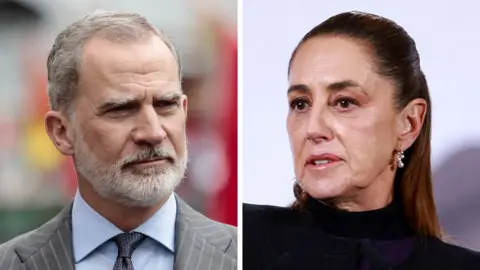
In a recent statement, King Felipe VI of Spain acknowledged the abuses that took place during the conquest of Mexico, an admission that has sparked a renewed debate about the actions of Spanish conquistadors and their lasting impact on Mexico and indigenous cultures. His comments were made during a visit to an exhibition in Madrid dedicated to indigenous women, where he lamented the 'lots of abuse' that occurred during the conquest. This recognition represents a significant moment in terms of reconciliation efforts between Spain and Mexico, as relations have been strained over historical grievances.
Mexican President Claudia Sheinbaum welcomed the king's remarks, viewing them as a step toward addressing historical injustices though she noted that more dialogue is necessary. She regarded the comments as an acknowledgment of not only the excesses experienced by indigenous peoples during colonization but also as an open door to reconciliation.
The Spanish conquest, initiated by figures like Hernán Cortés in the late 15th century, not only spread Spanish language and Christianity but also resulted in significant death and suffering among indigenous populations due to military action and diseases brought by the Europeans. The year 2021 marked the 500th anniversary of the fall of Tenochtitlán, the Aztec capital, and discussions about Spain's colonial past have intensified since then.
The political landscape in Spain has shown division regarding this acknowledgment. While many, including members of the current socialist-led administration, support King Felipe's remarks, leaders from the conservative People's Party criticized the king, insisting that reappraising historical events through a modern lens is inappropriate. The far-right Vox party backed this stance by describing the conquest as a positive chapter in history, sparking further contention over Spain's colonial legacy. As the dialogue continues, King Felipe's recognition of past abuses opens up discussions on how to confront and understand the historical narrative shared by Spain and Mexico.
Mexican President Claudia Sheinbaum welcomed the king's remarks, viewing them as a step toward addressing historical injustices though she noted that more dialogue is necessary. She regarded the comments as an acknowledgment of not only the excesses experienced by indigenous peoples during colonization but also as an open door to reconciliation.
The Spanish conquest, initiated by figures like Hernán Cortés in the late 15th century, not only spread Spanish language and Christianity but also resulted in significant death and suffering among indigenous populations due to military action and diseases brought by the Europeans. The year 2021 marked the 500th anniversary of the fall of Tenochtitlán, the Aztec capital, and discussions about Spain's colonial past have intensified since then.
The political landscape in Spain has shown division regarding this acknowledgment. While many, including members of the current socialist-led administration, support King Felipe's remarks, leaders from the conservative People's Party criticized the king, insisting that reappraising historical events through a modern lens is inappropriate. The far-right Vox party backed this stance by describing the conquest as a positive chapter in history, sparking further contention over Spain's colonial legacy. As the dialogue continues, King Felipe's recognition of past abuses opens up discussions on how to confront and understand the historical narrative shared by Spain and Mexico.