Saudi Arabia's foreign ministry has called for Yemen's southern factions to attend a 'dialogue' in Riyadh, after a dramatic turn of events in the south brought Saudi Arabia and the United Arab Emirates into unprecedented direct confrontation.
Both Gulf powers have intervened on behalf of Yemen's internationally recognised government in the country's long-running civil war, but a fracturing of the alliance has seen them backing different rival groups on the ground.
One of the groups is now pushing to declare the independence of a breakaway state in southern Yemen.
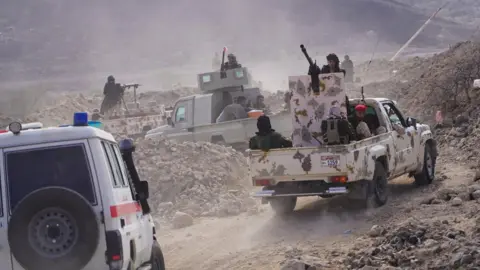
On Friday, the UAE-backed force declared that a 'war' had begun, accusing Saudi-backed ground forces of launching an attack alongside air strikes by the Saudi air force.
The Saudi ministry urged 'a comprehensive conference in Riyadh to bring together all southern factions to discuss just solutions to the southern cause' in a statement on social media. Riyadh stated that the Yemeni government had issued the invitation for talks.
Yemen's civil war broke out in 2014 and has plunged the already impoverished country into years of deadly violence and one of the world's worst hunger crises.
A ceasefire has de-escalated the conflict with the Houthis in recent years and led to a freezing of the front lines. However, the Saudi-backed ruling coalition has frayed, while the UAE-backed STC has taken control of much of southern Yemen.
The infighting escalated on December 2 when the STC launched a large-scale offensive, rapidly taking control of territory, including the oil-rich Hadramawt province that borders Saudi Arabia.
Tensions escalated further as air strikes by the Saudi-led coalition reportedly killed seven individuals at an STC military camp in Hadramawt. The STC claims their offensive is necessary to restore stability, but the head of the Presidential Leadership Council denounced it as a rebellion threatening national unity.
The UAE denied allegations that it was shipping weapons and agreed to withdraw its forces from Yemen after Saudi airstrikes on locations harboring its military hardware.
As fighting continues, the humanitarian situation in Yemen worsens, with millions of people in need of assistance. Observers are drawing parallels between the conflict's evolving landscape and a proxy war between two Gulf powers.