In brief
As the fires fueled by high winds continue to spread, emergency services battle the blaze while citizens take precautions.
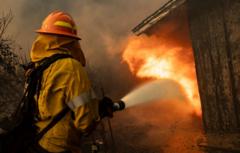
A major wildfire in California has led to urgent evacuation orders for thousands of residents as flames consume vast areas for a second consecutive day. The blaze was first reported near Moorpark, approximately 40 miles northwest of Los Angeles, early on Wednesday morning, exacerbated by heavy winds that have made containment increasingly challenging.Governor Gavin Newsom confirmed in a recent statement that over 10,000 evacuation orders have been issued, affecting homes, businesses, and structures with about 3,500 locations currently in immediate risk. The federal government has allocated funds to aid in combating the flames, and the National Weather Service has indicated that winds are expected to subside by Thursday night. However, they caution that fire danger conditions will remain prevalent.Visual reports from the scene depict dark smoke billowing into the sky, enveloping entire neighborhoods. Ventura County Fire Chief Dustin Gardner noted that the fire is advancing "dangerously fast," destructively moving through grasslands, bush areas, and structures. As of Wednesday, authorities reported two individuals suffering from smoke inhalation, with hospital care provided, while no firefighters have sustained serious injuries.Local officials in various Southern California counties are advising citizens to brace for rapid-fire spread and potential hazards, including power outages and fallen trees. The City of Ventura has likewise requested that residents conserve water, thus ensuring that firefighters have adequate resources to combat the fire's expansion.Schools in Ventura County have been forced to close their doors on Thursday, affecting over 20 institutions as safety measures are tightened. The blaze ignited during a Santa Ana wind episode, notorious for strong and dry wind conditions that can escalate fire risk. Forecasters recorded gusts of wind reaching 70 to 80 mph in certain parts of Los Angeles County, contributing to the rapid fire spread which has grown from approximately 0.5 square miles to over 16 square miles in just five hours.California has faced persistent wildfire threats, and studies show that burned areas during summer have seen a fivefold increase from 1996 to 2021 when compared to earlier decades, largely attributed to climate change concerns. While not every wildfire can be directly linked to this phenomenon, the consequences of climate variance have made conditions conducive for wildfires, including extreme heat and drought scenarios.