In brief
In the aftermath of Syria's brutal civil war, forensic teams are tasked with identifying countless victims from mass graves. With limited resources and overwhelming remains, the journey towards justice and closure continues to be a monumental challenge.
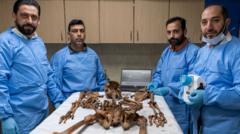
Empty lineDoctors and forensic specialists at the newly-established Syrian Identification Centre are confronting the monumental challenge of identifying remains from a mass grave outside Damascus, as the struggle for justice lingers in the aftermath of the Syrian civil war. Dr. Anas al-Hourani, the centre's head, is surrounded by neatly organized femurs, a visceral reminder of the horrors experienced by countless victims, believed to be among the hundreds of thousands killed under the oppressive rule of the Assad regime.This "mixed mass grave" consists of bodies piled atop one another, leading to a complex identification process. Dr. al-Hourani explains that the remains of these individuals can provide essential information about their identities—height, sex, age, and possibly signs of torture—though DNA testing remains a significant hurdle due to a single testing center and the scarcity of necessary chemicals caused by ongoing sanctions. “This will take years,” he laments, emphasizing the long road ahead for identification.Many in Syria who lost loved ones remain dissatisfied with what they see as a slow-moving process of "transitional justice," spearheaded by the new Islamist-led government. While efforts have been made, frustration simmers in the faces of countless relatives longing for closure. Human rights organizations estimate over 130,000 Syrians disappeared during the conflict, making every identified body crucial for grieving families.A visit to a distant, rugged hillside reveals 11 apparent graves, with Abu Ali, a former military driver, recounting his chilling experience of transporting bodies under Assad’s regime. His chilling cargo of civilian corpses starkly depicts the brutality faced during the war—individuals given numerical identification instead of names, their existences reduced to mere statistics in a violent narrative.As the grass withers over the graves, survivors like Malak Aoude continue to yearn for their disappeared loved ones. Both her sons were victims of the regime's oppressive clutches; Mohammed was killed after being caught protesting against the government, while Maher disappeared from school. Searching for any clue about his fate, she finds only despair, making a connection to a past filled with trauma and loss. With unquenchable hope for the future following the regime's recent fall, she remains stuck in a waiting game for the truth—"I thought there was a 90% chance [Maher] would walk out of prison," she shares, encapsulating the agony endured by many grieving families.As forensic work continues in identifying the remains, the scars of the past remain vividly etched in the present, reminding both the survivors and the international community of the cost of conflict in Syria. Each discovery brings both the promise of justice and the sorrow of memories lost, as the country grapples with its haunting legacy.