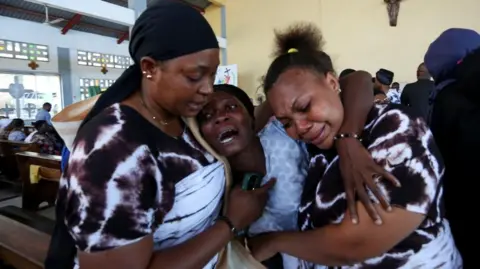
Western embassies in Tanzania, including the UK and France, have called on the authorities to release all bodies of those killed in the October electoral violence to their families.
Citing credible reports, the 17 missions said there was evidence of extrajudicial killings, disappearances, arbitrary arrests and the concealment of bodies by Tanzanian authorities during the unrest.
Tanzania has not commented but the statement comes just days after President Samia Suluhu Hassan angrily hit out Western nations, accusing them of interfering in the country's internal affairs.
Hundreds are reported to have been killed in the violence, though the government has not released an official toll.
The authorities violently cracked down on widespread demonstrations after the 29 October presidential election, in which President Samia was declared the winner with nearly 98% of the vote.
Samia's main rivals were barred, prompting widespread anger over the fairness of the presidential contest, which the opposition denounced as a mockery of democracy.
The authorities also imposed an internet blackout and threatened anyone sharing photos from the protests.
Samia has defended the fairness of the election and rejected criticism of her human rights record.
At least 240 people were charged with treason after the protests, but the president later sought to ease tension and asked prosecutors to show leniency. Many of those charged have reportedly already been released.
Opposition leader Tundu Lissu was charged with treason in April and remains behind bars.
In a joint statement on Friday, the coalition of Western embassies in Tanzania urged President Samia's government to free political prisoners and allow detainees to get legal and medical help.
We call on the authorities to urgently release all the bodies of the dead to their families, added the statement issued by the European Union delegation, several EU member countries, Canada, Norway and Switzerland.
They welcomed the government's decision to investigate the causes and circumstances of the violence but stressed that the probe be independent, transparent, and inclusive, involving civil society, faith-based organisations, and political stakeholders.
Amid growing diplomatic pressure on Tanzania, the UN human rights office reported intensified crackdowns against opponents following the vote.
The US government has indicated it is reconsidering relations with Tanzania due to the heavy-handed response against protesters.
President Samia has defended her government’s actions as necessary to maintain order, insisting her administration anticipates further demonstrations.