In brief
Infrastructure of the Havat Gilad outpost sits atop hilltops overlooking multiple Palestinian villages. After a guard was killed, settlers launched violent attacks, killing four Palestinians and an Israeli soldier. A resident, Yehuda Shimon, told the BBC that these attacks were justified as revenge. His statements echo extremist views that downplay Palestinian lives and challenge legal and humanitarian norms. The incident underscores the escalating conflict between Israeli settlers and Palestinian residents, where Israeli law shields settlers while Palestinians face military occupation and restrictions.
Havat Gilad, an illegal outpost deep inside the occupied West Bank, looms over neighboring Palestinian villages. Since Israel’s occupation in 1967, the outpost has served as a fortified enclave for settlers, with its shacks and blockhouses visible from far‑flung settlements.
The outpost’s security guard was killed in a confrontation in the adjacent village of Tal on July 30. The incident escalated into a wave of settler assaults that killed four Palestinians and injured dozens, and also claimed one Israeli soldier’s life. Amid this turmoil, the BBC interviewed Yehuda Shimon, a lawyer for a group that represents Israeli settlers facing accusations of violence against Palestinians.
Shimon told reporters that the attacks were a justified retaliation for the guard’s death. "We need to kill all people in Tal, Sarra, even Jit and Farata," he warned. He equated one Israeli life with millions of Palestinian lives, dismissing international law as irrelevant because he claimed the Bible granted Jews sovereignty over the land.
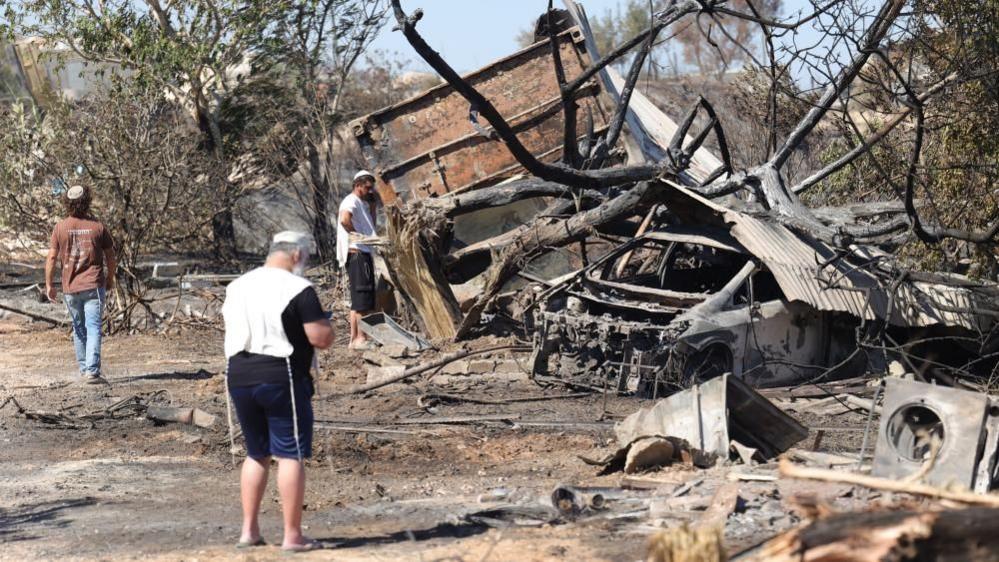
Settlers stand beside ashes of a burnt hut after an arson attack, police say accidental.
Local Palestinians reported feeling unprotected, with Israeli forces prioritizing settler security while Israeli courts have only recently begun addressing settler‑related incidents. The outpost’s expansion has been blocked by land claimed as Palestinian private property, forcing settlers to build illegally on state-designated land to the south.
Shimon’s interview highlighted a broader narrative that critics say amounts to apartheid. He urged Palestinians either to live quietly under Israeli rule or face extermination, echoing a government blueprint that encouraged voluntary migration of Palestinians from Gaza and the West Bank. The conflict remains unequal, with Israeli settlers protected by a powerful military while Palestinian residents navigate checkpoints and military courts.
Additional reporting by Oren Rosenfeld and Rebecca Hartmann.