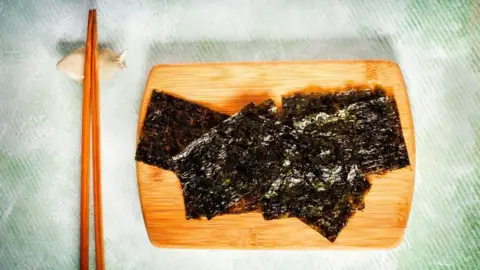
Black, crispy, often flat and square - dried seaweed, known locally as gim - is a humble staple on everyday dining tables across South Korea. But as its global popularity grows, its rising prices are worrying gim-lovers nationwide.
Lee Hyang-ran has been selling gim for the past 47 years.
In the past, people from Western countries thought Koreans were eating something weird that looks like a piece of black paper, she says from a small market stall in central Seoul. I never thought I'd be selling gim to them. But now, they all come here and buy it.
South Korea is known to be the world's largest producer and exporter of gim, supplying markets across Asia, North America and Europe. Some even refer to the product as Korea's black semiconductor, a reference to South Korea's large share of the global semiconductor industry.
Exports have risen steadily in recent years - and in 2025, South Korea's dried seaweed exports hit a record US$1.13bn, according to the Korea Maritime Institute (KMI).
And as demand rises, so do prices.
Known locally as an affordable snack or ingredient, gim typically cost around 100 won ($0.06; £0.05) per sheet in 2024 - with the snack usually sold in bundles of 10 sheets or more, or around $0.60 per pack.
But last month, the price of one sheet of gim rose to above 150 won - a record high in the country.
Premium products now cost as much as 350 won per sheet, said Lee.
The worldwide appetite for gim reflects a growing global demand in Korean goods, driven by cultural influences like K-pop and K-dramas. As global audiences engage more deeply with such entertainment, they're also increasingly looking to Korean cuisine, something businesses worldwide have picked up on.
In 2023, US supermarket chain Trader Joe's Gimbap - a Korean rice roll wrapped in seaweed - went viral and was cleared off the shelves nationwide shortly after its launch.
Government officials and experts say the price increase is being driven by multiple factors, including overall inflation, rising labour costs, and a decline in overseas production. However, many agree that increased growing global demand remains a major driver.
Back in Seoul, the market buzzes with tourists, and business is booming for Lee. Gim has been selling like hot cakes... the ones for making gimbap are especially popular, she says. I'm glad Korean gim is getting popular.