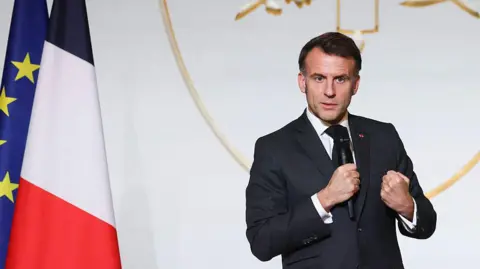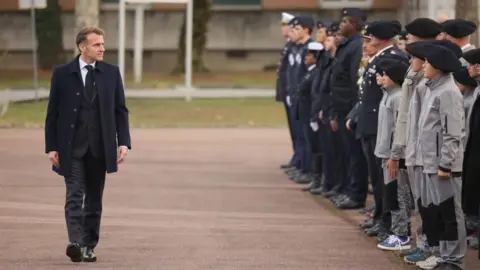
A limited form of military service will be re-introduced in France in response to growing fears of a confrontation with Russia. More than 25 years after conscription was phased out, the plan will see young men and women volunteering for a paid 10 months of military training. The only way to avoid danger is to prepare for it, President Emmanuel Macron said while announcing the plan at an infantry base near Grenoble in south-east France. We need to mobilise, mobilising the nation to defend itself, to be ready and remain respected.
The new national service will be brought in gradually from next summer, mainly for 18- and 19-year-olds, who will receive at least €800 (£700) a month.
In this uncertain world where might triumphs over right, war is in the present tense, said Macron. The armed forces would benefit from motivated young French men and women, he added: It is an act of trust in our youth.
Initially, numbers will be restricted to 3,000 next year, but this should rise to 50,000 by 2035. France currently has around 200,000 military personnel and a further 47,000 reservists. The new scheme should usher in a three-tier structure, comprising professionals, reservists, and volunteers.
The change brings France in line with other European countries that have launched military service schemes - with varying parameters - because of fears of Russian aggression. Belgium and the Netherlands have introduced a voluntary military service, and Germany is planning something similar.
Only this month, the Belgian defence ministry sent letters to 17-year-olds inviting them to volunteer for about €2,000 (£1,750) a month. Further east, Lithuania and Latvia have compulsory schemes, with cadets chosen by lottery. Sweden, which recently joined NATO, has started a nine- to 15-month military service with selection on merit.
Some European countries, like Finland and Greece, have never stopped military service, while the Swiss are set to vote on Sunday on replacing mandatory service for men with compulsory civic duty for all. Others, including the UK and Spain, currently have no plans to re-introduce it.
French military chiefs are broadly in favour of the new measure, which they hope will create a reservoir of trained personnel able to back up professional soldiers and replace them in non-frontline tasks. It is also hoped many volunteers will stay on to lead full military careers. Polls show a large majority of the public in favour of voluntary military service, with an Elabe survey indicating that 73% supported the measure.
This move reflects a significant shift in French military policy, with the threat from Russia becoming a prominent concern in national discourse. As the government works to prepare young people for potential challenges, the full details of this initiative will continue to unfold in the coming months.
The new national service will be brought in gradually from next summer, mainly for 18- and 19-year-olds, who will receive at least €800 (£700) a month.
In this uncertain world where might triumphs over right, war is in the present tense, said Macron. The armed forces would benefit from motivated young French men and women, he added: It is an act of trust in our youth.
Initially, numbers will be restricted to 3,000 next year, but this should rise to 50,000 by 2035. France currently has around 200,000 military personnel and a further 47,000 reservists. The new scheme should usher in a three-tier structure, comprising professionals, reservists, and volunteers.
The change brings France in line with other European countries that have launched military service schemes - with varying parameters - because of fears of Russian aggression. Belgium and the Netherlands have introduced a voluntary military service, and Germany is planning something similar.
Only this month, the Belgian defence ministry sent letters to 17-year-olds inviting them to volunteer for about €2,000 (£1,750) a month. Further east, Lithuania and Latvia have compulsory schemes, with cadets chosen by lottery. Sweden, which recently joined NATO, has started a nine- to 15-month military service with selection on merit.
Some European countries, like Finland and Greece, have never stopped military service, while the Swiss are set to vote on Sunday on replacing mandatory service for men with compulsory civic duty for all. Others, including the UK and Spain, currently have no plans to re-introduce it.
French military chiefs are broadly in favour of the new measure, which they hope will create a reservoir of trained personnel able to back up professional soldiers and replace them in non-frontline tasks. It is also hoped many volunteers will stay on to lead full military careers. Polls show a large majority of the public in favour of voluntary military service, with an Elabe survey indicating that 73% supported the measure.
This move reflects a significant shift in French military policy, with the threat from Russia becoming a prominent concern in national discourse. As the government works to prepare young people for potential challenges, the full details of this initiative will continue to unfold in the coming months.