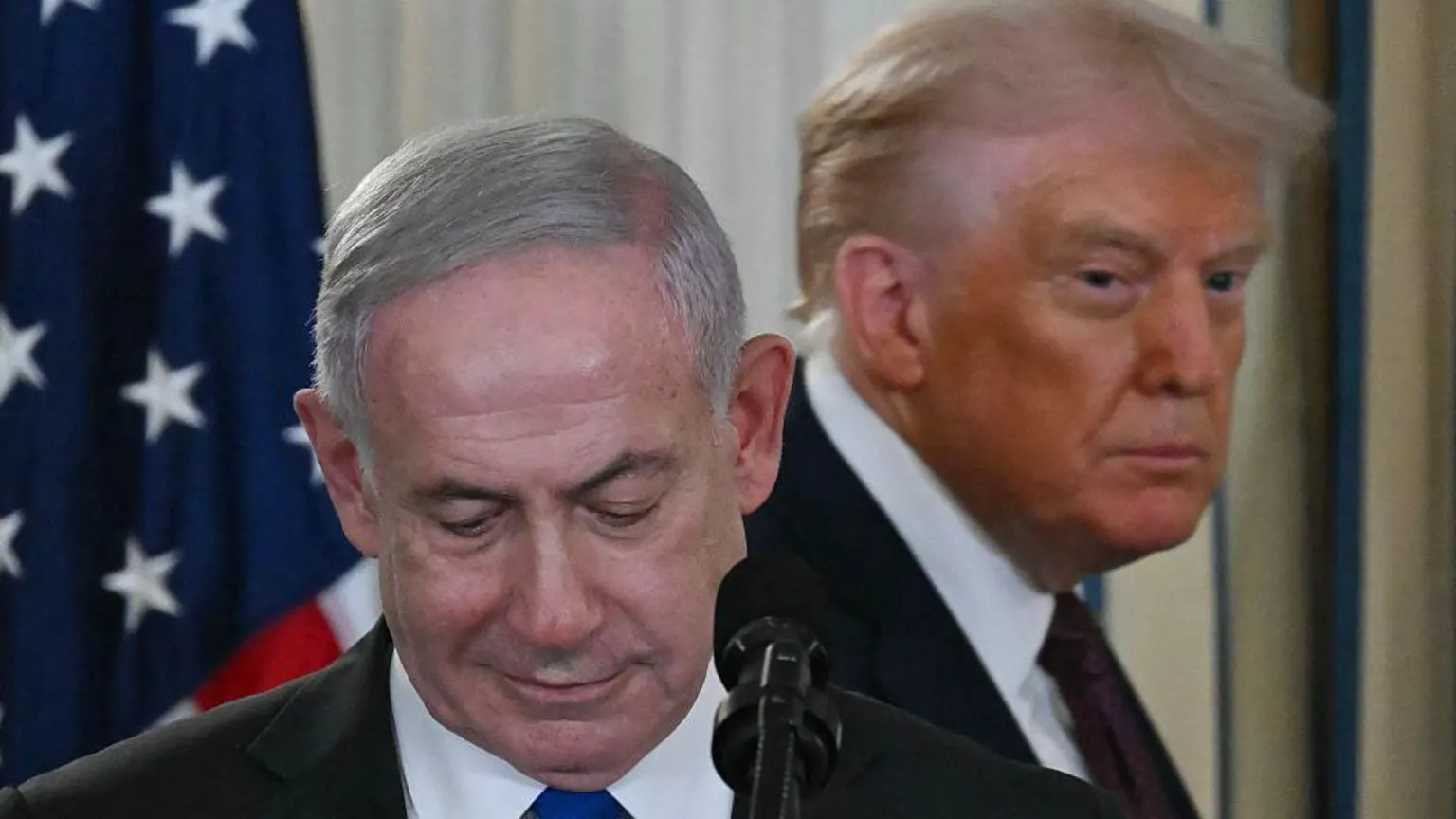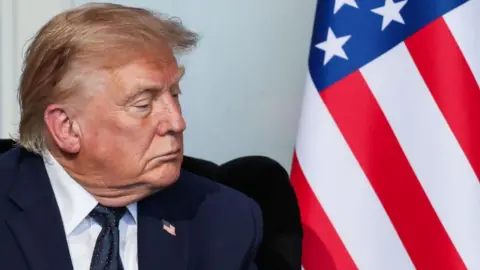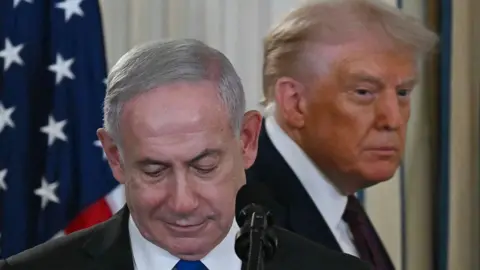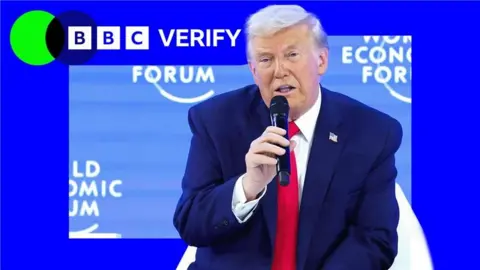
In a free-wheeling speech to world leaders at the World Economic Forum in Davos, Switzerland, President Trump made a series of contested claims.
Trump touched on his desire to obtain Greenland from Denmark - which he referred to as a 'small ask', America's contribution to NATO, and wind energy in China.
His address - which lasted for more than an hour - contained a number of false assertions which BBC Verify has been looking at.
Did the US 'give Greenland back' after World War Two?
For weeks, Trump has spoken about his desire to acquire Greenland, a largely self-governing territory of Denmark. He has said it is critical to US national security.
At Davos, he said that after World War Two 'we gave Greenland back to Denmark,' adding: 'How stupid were we to do that?'
However, it was not America's to give back. In 1933, an international court ruled that Greenland belonged to Denmark. Agreements made during WWII led to the construction of US bases, but these did not amount to territorial claims.
Is the US paying for 'virtually 100%' of NATO's defense?
Trump claimed that 'the United States was paying for virtually 100% of NATO'. In reality, US spending has accounted for about 70% of total spending by NATO countries recently, with commitments from allies increasing over time.
Has the US got nothing back from NATO?
Trump stated that the US had 'never gotten anything' from NATO. This is misleading, as US allies have contributed troops in various conflicts, including post-9/11 operations in Afghanistan.
Does China have no wind farms?
Trump claimed he couldn't find wind farms in China despite the country being the largest producer of wind energy globally. The Gansu wind farm in China is among the largest in the world, visible even from space.
Does the UK take 92% of North Sea oil revenue?
Trump erroneously claimed that the UK takes 92% of North Sea oil revenues. In fact, taxes are assessed on profits, with a total tax rate of about 78% on profits, not revenues.
Has Trump secured $18 trillion worth of investments for the US?
Trump's claim of securing $18 trillion in investments lacks supportive public evidence and appears exaggerated compared to verifiable commitments.
Each of these erroneous claims highlights the necessity for accurate information in public discourse, especially during high-stakes international engagements.