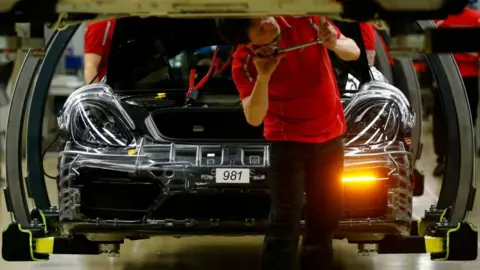
The European Union has watered down its plans to ban the sale of new petrol and diesel vehicles by 2035. Current rules state that new vehicles sold from that date should be zero emission, but carmakers, particularly in Germany, have lobbied heavily for concessions.
Under the European Commission's new plan, 90% of new cars sold from 2035 would have to be zero-emission, rather than 100%. According to the European carmakers association, ACEA, market demand for electric cars is currently too low, and without a change to the rules, manufacturers would risk multi-billion euro penalties.
The remaining 10% could be made up of conventional petrol or diesel cars, along with hybrids. Carmakers will be expected to compensate for the extra emissions created by these vehicles by using biofuels and so-called e-fuels, which are synthesised from captured carbon dioxide. They will also be expected to use low-carbon steel made in the European Union in the vehicles they produce.
Opponents of the move have warned that it risks undermining the transition towards electric vehicles, leaving Europe exposed to foreign competition. The green transport group T&E has cautioned that the UK should not follow the EU's lead in weakening its own plans for phasing out the sale of conventional cars under the Zero Emission Vehicles Mandate. T&E UK's director Anna Krajinska emphasized that the UK's mandate is already driving jobs, investment, and innovation into the country, asserting that UK cannot compete unless it innovates as global markets swiftly transition to electric.
Under the European Commission's new plan, 90% of new cars sold from 2035 would have to be zero-emission, rather than 100%. According to the European carmakers association, ACEA, market demand for electric cars is currently too low, and without a change to the rules, manufacturers would risk multi-billion euro penalties.
The remaining 10% could be made up of conventional petrol or diesel cars, along with hybrids. Carmakers will be expected to compensate for the extra emissions created by these vehicles by using biofuels and so-called e-fuels, which are synthesised from captured carbon dioxide. They will also be expected to use low-carbon steel made in the European Union in the vehicles they produce.
Opponents of the move have warned that it risks undermining the transition towards electric vehicles, leaving Europe exposed to foreign competition. The green transport group T&E has cautioned that the UK should not follow the EU's lead in weakening its own plans for phasing out the sale of conventional cars under the Zero Emission Vehicles Mandate. T&E UK's director Anna Krajinska emphasized that the UK's mandate is already driving jobs, investment, and innovation into the country, asserting that UK cannot compete unless it innovates as global markets swiftly transition to electric.