
In brief
The accidental discovery of the Mayan city, dubbed Valeriana, underscores the complexity of ancient civilizations that thrived in the tropical environment, shifting prevailing perceptions.
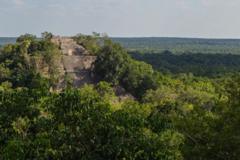
In a remarkable twist of fate, archaeologist Luke Auld-Thomas stumbled upon the remnants of an enormous Mayan city in the heart of Mexico's jungle. Named Valeriana, the city, boasting impressive pyramids, sports fields, and interconnected districts, was uncovered using Lidar, a groundbreaking remote sensing technology that maps structures hidden under vegetation. Situated in Campeche, the ancient metropolis is now believed to rival Calakmul as the largest Mayan site in ancient Latin America.The serendipitous discovery occurred when Auld-Thomas, a PhD student at Tulane University, was searching online for a radar survey conducted by a Mexican environmental monitoring organization. The Lidar technology, which emits thousands of radar pulses from an aircraft and analyzes the return signals, revealed extensive urban infrastructure from what was once a bustling city, possibly home to 30,000 to 50,000 inhabitants during its height between 750 and 850 AD. Its size is comparable to Edinburgh, the capital of Scotland.Co-author of the research, Professor Marcello Canuto, describes this find as a vital step in reshaping the misconception that tropical regions were devoid of thriving civilizations. This newly discovered site, hidden just a 15-minute walk from a major road, provides evidence that complex societies were present and evolved in the lush jungles of Mesoamerica.With its two primary centers of activity, Valeriana spanned approximately 16.6 square kilometers and featured significant architectural elements, including plazas, temple pyramids, and even a court for playing ancient ball games. Researchers found numerous structures, totaling 6,764 buildings, along with reservoirs suggesting an advanced understanding of landscape management to sustain a large population.The implications of this discovery extend beyond just uncovering lost architecture. Experts believe the dense population combined with climate instability likely contributed to the decline of Mayan civilization around 800 AD. The research, published in the journal Antiquity, reveals evidence that warfare and Spanish colonization further exacerbated the downfall of these city-states.Lidar technology has drastically changed archaeological surveying methods over the past decade, offering hope for discovering many more hidden cities within dense forest cover. Auld-Thomas believes there are still countless sites yet to be identified, highlighting the significance of this discovery while acknowledging the challenge of studying multiple newly found locations simultaneously. As the research community continues to explore these ancient wonders, the legacy of civilizations that once flourished in the jungle is slowly being unveiled.
