In brief
Despite the embarrassment, experts suggest the incident is part of a strategic effort to solidify loyalty to Kim's leadership while pursuing military advancements.
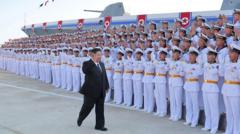
In January, a new North Korean warship met with disaster as it capsized during its launch, instantly capturing global attention. The interest transcended the absence of casualties or significant hull damage, focusing instead on Kim Jong Un’s forceful reaction. Declaring the mishap a “criminal act,” Kim emphasized the need to restore the ship's dignity and called for accountability, which led to the arrest of several officials. This incident underscores North Korea's commitment to evolving its military forces, particularly the navy, as it strives to compete with superior maritime powers like the U.S. and South Korea. Analysts note that Kim has prioritized modernizing the navy to augment the country’s nuclear capabilities, given that its current naval strength is comparatively weak. The capsized vessel, a destroyer capable of launching nuclear short-range missiles, symbolizes a crucial step in achieving this goal.Retired South Korean navy captain Choi Il pointed out that such failures are unusually severe for advanced warship construction, hinting at North Korea's limitations in shipbuilding technology. The launch, attended by Kim and his daughter, was expected to showcase the regime's military prowess, adding to the embarrassment when it failed.However, analysts propose that Kim’s decision to publicize the incident represents a strategic pivot in his governing style, which has previously prioritized secrecy over transparency. Rachel Minyoung Lee from the Stimson Center suggests that welcoming accountability is part of a shift in strategy, where the leadership acknowledges problems publicly to reinforce confidence in its governance.The speedy repair of the warship, completed in just over three weeks, demonstrates the regime's ability to turn failure into political triumph, while simultaneously reinforcing loyalty to Kim's leadership. In the wake of the capsize, instead of positioning himself as infallible, Kim praised a worker who died during the ship’s construction, transforming the narrative into one of dedication and sacrifice.Experts assert that this incident exemplifies Kim's adaptability in narrative control, with a focus on emphasizing progress towards a nuclear-armed naval force. Both Choi and Lee stress that while North Korea's military capabilities may seem rudimentary compared to global standards, there is significant progress. The transformed navy is envisioned to project power across oceans and enable pre-emptive strikes – a development that commands caution from international observers and regional adversaries alike.As analysts and experts closely monitor North Korea’s military advancements, the capsized warship incident serves as a pivotal moment, illustrating the country’s strategies, challenges, and aspirations on the global stage.