In brief
Madrid has announced strict controls at all airports and ports carrying passengers from Italy, effective midnight and lasting thirty days, to curb the flow of migrants that recently entered the Spanish enclave of Ceuta from Morocco. The move follows Italy's own temporary suspension of Schengen cooperation after the arrival of roughly 78,000 migrants in Ceuta. Airports in Rome and other Italian hubs report random passport checks, causing long queues and travel delays. Spain criticises Italy’s rationale as lacking legal footing, while Rome defends the measures as necessary to protect the EU interior. The crisis, already involving dozens of deaths and thousands of minors, may trigger a second wave of crossings in September, analysts warn.
The Spanish government announced at 22:00 GMT that all flights and ships arriving from Italy would be subject to a new month‑long border check regime. The decision comes after a week of nearby turmoil: Italy had already tightened controls in response to roughly 78,000 migrants who crossed from Morocco into Ceuta, its North‑African enclave.
Spain says that 5‑10 % of passengers will have their documents screened before disembarkation. Italian officials, meanwhile, claim their checkpoints are random and only target non‑EU travellers, though how officers separate EU nationals from others remains unclear to observers.
The crisis has put Spain’s socialist leader Pedro Sánchez and Italy’s conservative prime minister Giorgia Meloni in direct conflict. Madrid labels Rome’s temporary suspension of the Schengen “spurious” and insists it has no basis, because migrants in Ceuta have no rail or road route into the main Schengen area.
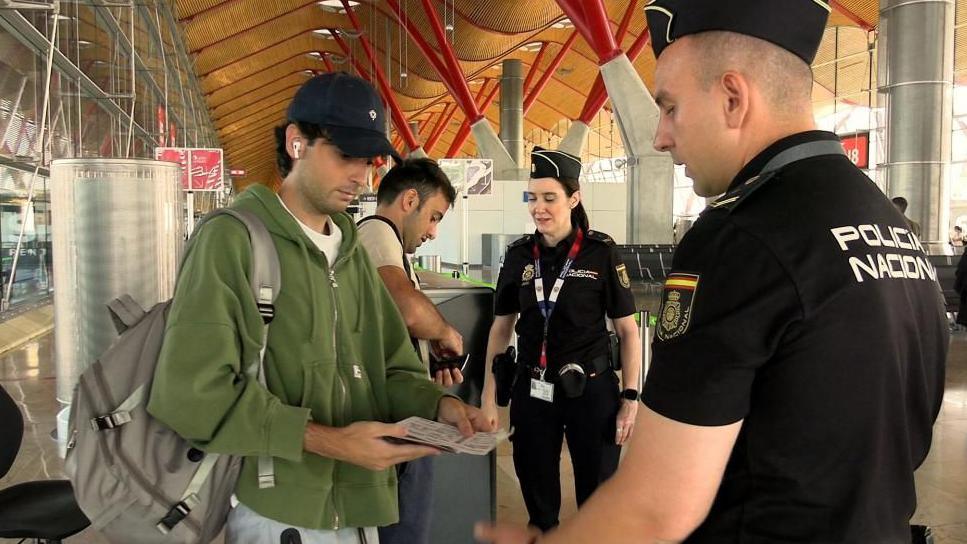
Rome states its controls will remain until 15 August, when the Italian government predicts a new wave of migration could hit Ceuta again. Italian flights see long queues, with passengers directed to a special line for checks.
An illustrative image from Reuters shows two police officers in black uniforms staring over a passport and wallet.
In Ceuta, the crisis continues. Many migrants were returned to Morocco within days, but the Spanish authorities still report that several thousand people remain, including around 1,400 minors. Some journalists claim criminal networks spread misinformation that led to the sudden spike, a claim also accepted by the Spanish government.
The mass arrivals have strained Spanish‑Moroccan diplomatic ties; the latter does not recognise Spanish sovereignty over Ceuta and has blamed Spain’s Supreme Court ruling that prevented the swift return of sea‑bound migrants.
As tensions simmer, experts warn that further migration waves in September could pose significant logistical challenges for airlines, ports, and border check points. The situation remains fluid, with local authorities still monitoring flows but expressing little expectation of a repeat of last week’s chaotic scenes.