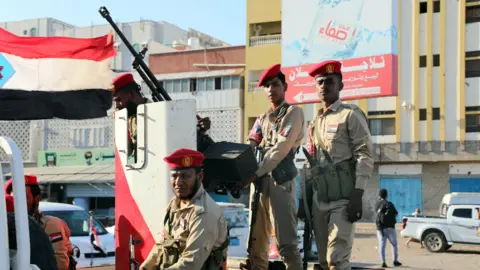
Saudi Arabia has backed a demand from Yemen's presidential council for the United Arab Emirates (UAE) to withdraw within 24 hours, after a Saudi-led coalition bombed what it said was a weapons shipment for UAE-backed separatists at the port of Mukalla.
The Saudi foreign ministry accused the UAE of pressuring the Southern Transitional Council (STC), which seeks independence for southern Yemen, to launch recent offensives in the eastern provinces of Hadramawt and al-Mahra.
The kingdom warned that it would take measures to confront what it deemed highly dangerous actions.
The UAE's foreign ministry denied that the shipment contained weapons and expressed deep regret at the Saudi statement, condemning the allegations and asserting it did not exert pressure on Yemeni military operations.
The STC leaders also stated that the ultimatum for the withdrawal of UAE forces had no legal basis and insisted on remaining a main partner in the battle against the Iran-backed Houthi movement.
Earlier on Monday, the head of the eight-member presidential council announced the cancellation of a joint defence pact with the UAE and ordered its forces to leave, affirming Yemen's unity, sovereignty, and stability. A state of emergency was declared for 90 days to confront the Houthis and internal strife led by mutinous military elements.\
Alimi's announcement followed a Saudi-led coalition spokesman's confirmation of a limited air strike targeting weapons and military vehicles for STC forces in the southern port of Mukalla, asserting they constituted an imminent threat to peace and stability.
The UAE's foreign ministry expressed surprise at the airstrike, claiming that the coalition's statement was made without consultation among its members.
The conflict in Yemen has left more than 150,000 dead and triggered one of the world's worst humanitarian crises. The ongoing tensions illustrate the complexities of internal conflicts involving both international and regional powers.