In brief
In the wake of his impeachment, President Yoon Suk Yeol leverages longstanding fears of communism, attracting both fervent supporters and exacerbating societal divides. As a growing number of Koreans believe in conspiracies linking the opposition to North Korea and China, experts warn of the lasting impact on the nation’s political landscape.
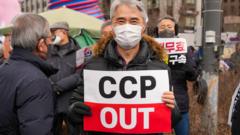
On a frigid January afternoon, Shin Jeong-min, a 22-year-old pharmacy student, anxiously filled the air outside South Korea's Constitutional Court along with other impassioned supporters rallying for their suspended president, Yoon Suk Yeol, who appeared to contest his impeachment. “Release him now. Cancel his impeachment,” they declared. The protestors, young and old alike, seemed united by their concerns that if Yoon were to be deposed and the opposition party take power, South Korea might drift towards a communist regime, influenced by North Korea’s Kim Jong Un. This narrative, while deeply entrenched among older generations who endured the Cold War, is now spilling into younger demographics. Many, who previously gave little thought to North Korea or its ideologies, have found themselves captivated by the notion that their democracy is at risk from left-wing forces. Yoon’s abrupt declaration of martial law in December evoked these historical fears, alleging without evidence that North Korean operatives had invaded the opposition party to destabilize South Korea. As the months passed since his failed coup, a wave of anti-communist fervor swept through Yoon's supporters. “This is a war between communism and democracy,” contended a participating office worker. Others echoed similar sentiments, insisting that without Yoon, the country would be overwhelmed by espionage threats.Historically, fears of communist infiltration facilitated the restriction of personal freedoms during South Korea's military dictatorship. Yoon’s rhetoric has been compared to that of these past authoritarian regimes, with accusations of the opposition harboring sympathizers proliferating. Critics from the Democratic Party, like lawmaker Wi Sung-lac, contend that these assertions are baseless tactics meant to defame the opposition while veiling Yoon’s own undemocratic maneuvers.Interestingly, these once fringe conspiracies, often dismissed in South Korean society, are gaining traction due to Yoon's position of power. As evidenced in recent pro-Yoon gatherings, former skeptics have shifted their views. The more one delves into their politics, the more they begin to perceive hidden agendas within the Democratic Party, some even blaming external actors for influencing the electoral process.The notion that China is complicit in undermining South Korea’s democracy has also gained momentum, as increasing numbers of South Koreans are reporting fears of becoming a subservient state. This sentiment is notably stronger among younger citizens, who now view China, an emerging power, as a more tangible threat compared to North Korea.Experts warn that this rising anti-communist narrative fueled by Yoon, paired with social media propagation, is likened to a fast-cultivating ideology that could reshape South Korean political engagement and trust in democratic processes. While many await a return to stability, the implications of this crisis pose fundamental uncertainties for South Korea’s political future.