In brief
The new MMX mission marks the first time a sample will be returned from a Martian moon. Launched from Japan, the probe is scheduled to arrive at Phobos in August 2027. It will land a rover, collect dust, and return it for detailed laboratory study on Earth. Scientists hope the data will reveal whether the moons formed from an impact or were captured asteroids. The mission could also bring Martian surface material embedded in Phobos, offering a unique window into Mars itself.
A Japanese spacecraft has lifted off toward Mars’ moon Phobos, the first probe to attempt a sample return from a Martian satellite.
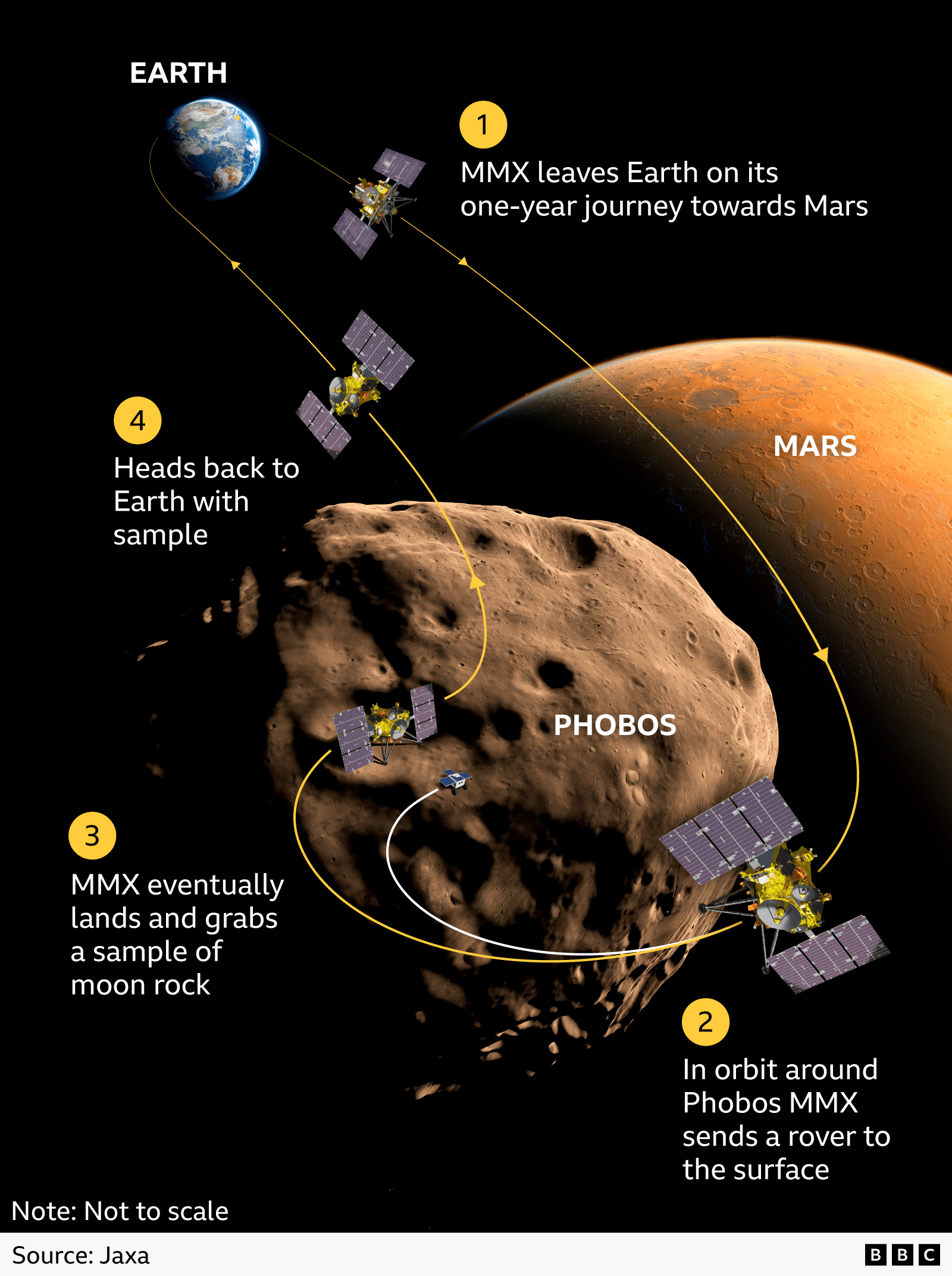
If the mission succeeds, the 10‑gram payload will be the first material from a Martian moon to be analysed in laboratories on Earth. The initiator, Japan’s Aerospace Exploration Agency, has planned an arrival date of August 2027 with the aim of landing the probe on the uneven, 20‑km diameter surface of Phobos.
Scientists hope the dust will answer whether Phobos formed from debris of a giant impact on Mars or is a captured asteroid from the outer Solar System. The twin hypotheses predict distinctly different chemistry; analysing the samples should resolve the debate quickly.
Landing a rover on such a small moon is challenging because Phobos’ gravity is weak yet neighbourhood to Mars’ strong field. The mission will send a small rover first to scout a suitable site, after which the MMX spacecraft will touch down, deploy a robotic arm and two collectors to scoop dust.
Once collected, the sample will be enclosed in a capsule that will return to Earth in 2031, aiming for a landing in the Woomera desert of South Australia. Although the sample is only about 10 g, experts say high‑precision analyses can still yield valuable data, making each gram worth the effort.
Beyond revealing Phobos’ origin, the mission may also provide spurious Martian material, as grains ejected from Mars can implant on Phobos’ surface. Studying such mixed material could give direct insights into Mars’ surface composition and history.
The idea of returning Martian material has been a long‑standing goal of planetary scientists. The NASA Perseverance rover has been selecting samples on Mars since 2021, but a joint NASA/ESA Mars Sample Return mission was cancelled after funding cuts. China plans its own Mars sampling launch in 2028, while a Moscow‑like inclusion of meteorites offers a less pristine but still informative source of data.