In brief
A team has unveiled the first glimpse into an ancient scroll, providing a tantalizing connection to thoughts from the past through cutting-edge techniques.
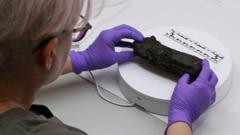
In a remarkable advancement in archaeology, researchers have digitally "unwrapped" a severely burnt scroll from the Roman town of Herculaneum, unveiling a view inside for the first time in 2,000 years. The ancient manuscript, which resembles a piece of charcoal due to the devastating eruption of Mount Vesuvius in 79 AD, is too delicate to physically open. However, with the aid of X-ray imaging and artificial intelligence, scientists are shedding light on its contents.While further work is required to fully understand the scroll, the project's team expresses confidence in their ability to read most of it. "We're confident we will be able to read pretty much the whole scroll in its entirety, and it's the first time we've really been able to say that with high confidence," shared project lead Stephen Parsons, who is spearheading the Vesuvius Challenge aimed at unlocking the secrets of the Herculaneum scrolls.The scroll, made of papyrus, was carbonized during the catastrophic eruption along with hundreds of other documents found in Herculaneum—a site similar to Pompeii, buried under layers of volcanic ash. Past attempts to physically open these scrolls resulted in their destruction, leaving them untouched for years at the University of Oxford's Bodleian Library."We've never been convinced before that any of the techniques would be safe enough or effective enough to get any information from the scrolls," stated Nicole Gilroy, the library's book conservation head. However, the potential of this high-tech approach motivated experts to retrieve a long-stored scroll.The scroll underwent examination at Diamond Light Source in Oxfordshire, a facility where electrons are accelerated to generate powerful X-ray beams. This technology allows an in-depth, non-destructive view of the ancient text. "It can see things on the scale of a few thousandths of a millimetre," explained Adrian Mancuso, a physical sciences director at Diamond.The X-ray scans yield a 3D reconstruction of the scroll's layers, essential for digitally deciphering its text, estimated to cover around 10 meters of papyrus. Following this, artificial intelligence becomes crucial in detecting the ink, which is challenging due to its carbon composition closely resembling the papyrus itself.With initial findings suggesting the presence of Greek letters, the team is optimistic about revealing more text soon. "We can tell the entire scroll is full of text," Parsons remarked, indicating that they might transition from deciphering scattered words to more substantial passages in the future. One previous Vesuvius Challenge team's success allowed them to read 5% of another scroll, which turned out to explore Greek Epicurean philosophy. The team suspects a similar theme for the Bodleian scroll and is calling upon further human and computational resources to confirm this hypothesis.As archaeologists delve into their findings, Gilroy resonates with the human connection, expressing appreciation for the bonds formed through history: "There's a real human aspect to it that I just think is really precious."