In brief
A report from Spain's CIAF rail investigation commission reveals that a fracture in the track contributed to the recent high-speed train disaster that killed 45 people. The report indicates that grooves on the wheels of trains that passed over the damaged track before the incident support the hypothesis of a prior fracture. The investigation is ongoing, aiming to ascertain detailed causes behind the catastrophic events.
A fracture in a straight section of track occurred prior to the passage of a high-speed train that derailed, causing last Sunday's rail disaster in which 45 people died, an initial report has found.
A train run by private company Iryo derailed last Sunday, with its rear carriages crossing onto the opposite track into the path of an oncoming train run by state-owned Renfe.
The CIAF rail investigation commission found that the Iryo train's front carriages, which remained on the track, had notches in their wheels. Notably, three earlier trains that traversed the same track exhibited similar notches.
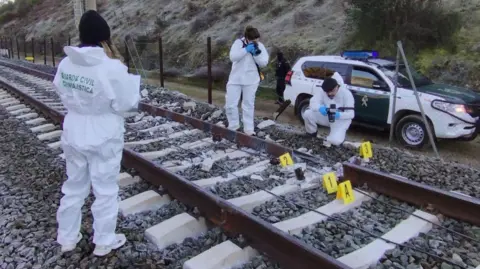
Investigators are focusing on a significant gap of nearly 40cm (15in) in the track as a potential cause of the crash.
This deadly collision occurred around 19:45 local time (18:45 GMT), roughly an hour after the Iryo train departed Málaga for Madrid.
The train's last three carriages - number six to eight - derailed and collided with the Huelva-bound Renfe train. Carriage six derailed due to a complete lack of continuity in the track, reveals the preliminary report.
Most fatalities and injuries were recorded in the front carriages of the state-operated train.
Earlier this week, Spanish Transport Minister Óscar Puente disclosed that grooves found on the wheels of the Iryo train's carriages had previously passed safely over the damaged track.
These findings indicated that the deformations observed in the track were likely due to the fracture, which cycled through the investigations with a clear need for corroborative analyses.
The tragic Adamuz disaster marks Spain's worst rail incident in over a decade, reminiscent of the 2013 Galicia derailment that resulted in 80 deaths and numerous injuries.