In brief
Barry Webb, an award-winning macro photographer, has opened up a hidden world through his lens, showcasing the intricate beauty of slime mould. His recent work won the people's choice award in the macro category at the British Photography Awards 2025, highlighting the significance of these organisms in ecosystems. The article delves into the techniques Barry uses to capture these microscopic marvels and their ecological importance.
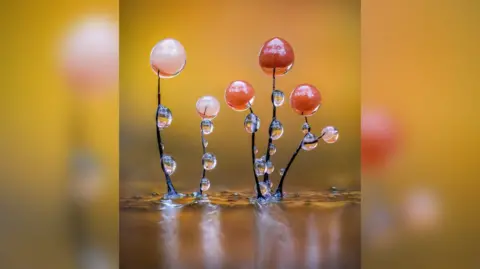
Welcome to the world of slime mould. These images, captured by photographer Barry Webb, provide a close-up view of single-celled slime mould organisms—perspectives unreachable by the naked eye.
Using a high-powered macro lens and a composite of still images, Barry reveals the tiny structures that thrive in a variety of environments, from forests to deserts.
Barry's photography, primarily focused west of London, earned him recognition, including the recent people's choice award in the macro section of the British Photography Awards.
Despite not knowing about slime mould until 2019, Barry embraced the opportunity to explore and photograph them extensively during the Covid lockdown. As a garden enthusiast and photography aficionado, he explains, It's not fungi, it's not a plant, it's not animal—it's more closely related to an amoeba. This unique perspective reveals the ecological significance of slime mould, which feeds on bacteria, algae, and fungi.
Not just a visual treat, slime mould has implications for science, showcased in applications ranging from urban transport mapping to the search for dark matter.
However, capturing these intricate details requires advanced techniques like focus bracketing, wherein Barry captures dozens of photos to create a composite that highlights the remarkable beauty of slime mould.
Through his lens, Barry invites us to appreciate the ecological role and aesthetic wonder of these extraordinary organisms.