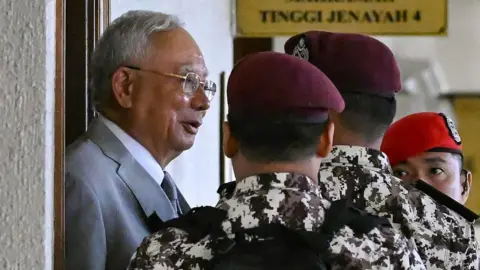
Former Malaysian Prime Minister Najib Razak has been jailed for 15 years for abuse of power and money laundering, marking a significant consequence of his involvement in a multi-billion-dollar state funds scandal.
Najib, now 72, faced allegations of misappropriating nearly 2.3 billion Malaysian ringgit (approximately $569 million) from the nation's sovereign wealth fund, 1Malaysia Development Berhad (1MDB).
A verdict delivered on Friday found him guilty on four charges of abuse of power and 21 charges of money laundering, amidst a backdrop of seven years of legal proceedings marked by the testimony of 76 witnesses.
This latest ruling is part of a continuing legal saga for Najib, who was previously sentenced to six years for another 1MDB-related crime. Following Friday's verdict, Najib received four concurrent 15-year sentences for abuse of power, as well as five years for each of the 21 money laundering counts.
The court's decision was handed down in Putrajaya, coinciding with a week that saw Najib's attempt to secure house arrest denied. Despite his incarceration, he continues to maintain a loyal base of supporters, who gathered outside the court to call for his release.
The 1MDB scandal, which first garnered international attention a decade ago, sparked a massive political fallout in Malaysia and implicated various luminaries, from Goldman Sachs executives to Hollywood stars, with estimates of about $4.5 billion siphoned from the fund for private use, including by Najib himself.
Najib's defense argued that he was duped by advisors, notably financier Jho Low, who remains a fugitive. Previously, courts have consistently found Najib guilty of embezzlement and financial misconduct related to state funds.
In 2020, Najib was convicted over 42 million ringgit ($10 million) received in his private accounts, from which he was sentenced to 12 years but had his term reduced last year.
Moreover, Najib insisted that funds he received in 2013 were a gift from the late Saudi King Abdullah, a claim rejected by the presiding judge.
His wife, Rosmah Mansor, also faced legal repercussions in 2022, receiving a ten-year sentence for bribery, though she remains free while appealing her conviction.
The fallout from the scandal has significantly impacted Malaysia’s political landscape, leading to the defeat of Najib’s long-governing coalition in 2018, and continuing tensions within the political party he represents.
The Prime Minister of Malaysia, Anwar Ibrahim, has urged a respect for the judiciary in light of these developments, and critics alike acknowledge that while the court rulings are pivotal, advancements in eradicating corruption remain limited.
Cynthia Gabriel from Malaysia's Center to Combat Corruption and Cronyism cautioned that “grand corruption continues in different forms,” leaving an uncertain future in combating corruption in Malaysian governance.