In brief
Research from Kibale National Park reveals that the Ngogo chimpanzees have been embroiled in a violent conflict for the past eight years, resulting in 24 recorded killings, mostly of infants. Factors such as territoriality and resource competition contribute to this unprecedented strife among a community known for its previous cohesion. The findings may provide insights into the roots of human conflict.
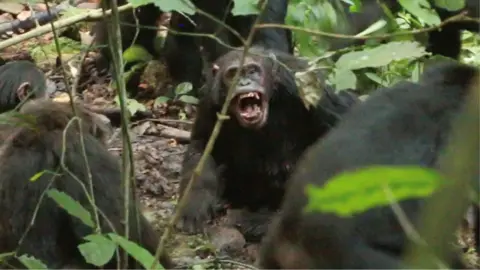
The world's largest known group of wild chimpanzees has split and has been locked in a vicious civil war for the last eight years, according to researchers.
It is not clear exactly why the once close-knit community of Ngogo chimpanzees at Uganda's Kibale National Park are at loggerheads, but since 2018 the scientists have recorded 24 killings, including 17 infants.
These were chimps that would hold hands, lead author Aaron Sandel said. Now they're trying to kill each other. The study, published in the journal Science, says the intensity and duration of the violence may inform how early human conflict developed.
Sandel, an anthropologist from the University of Texas in the US and co-director of the Ngogo Chimpanzee Project, explains that chimpanzees are very territorial, often engaging in hostile interactions with those from other groups. Over several decades, the nearly 200 Ngogo chimpanzees had lived in harmony, divided into two sets known as Western and Central, existing as a cohesive group.
The polarisation became evident in June 2015 when members of the Western group began running away from the Central group. Following what was supposed to be minor disputes, a notable change occurred leading to decreased interactions and heightened tensions between the groups.
Since the final separation in 2018, at least seven adult males and 17 infants from the Central chimpanzees have been killed in targeted attacks, although researchers believe the actual number may be even higher. They identified factors contributing to the conflict including disruptions in social networks, changes in group leadership, and a respiratory epidemic that weakened ties within the community.
The researchers argue their findings suggest that relational dynamics, rather than constructs such as religion or ethnicity, may play a significant role in prompting conflict, aligning with observations in human societies.
In the case of the Ngogo fission, individuals who lived, fed, groomed, and patrolled together for years became targets of lethal attacks based on their new group membership, they stated in their paper. James Brooks, a researcher at the German Primate Center, emphasized the importance of studying these divisions within chimpanzee societies as they provide critical insights into human group-based behavior, especially in contexts of conflict.