In brief
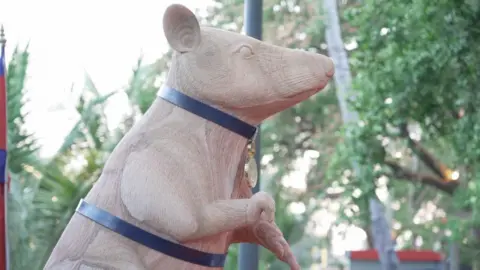
Magawa, a heroic mine-clearing rat known for detecting over 100 landmines, is immortalized in a statue unveiled in Siem Reap, Cambodia, on April 4, coinciding with International Day for Mine Awareness. The statue honors the rat's contributions to demining efforts and raises awareness about the ongoing risks of landmines in Cambodia.
A famous mine-clearing rat, who was awarded a gold medal for his heroism, has been commemorated with the world's first statue dedicated to a landmine-detecting rat. Magawa, who lived to eight years old, sniffed out over 100 landmines and other explosives in Cambodia during his five-year career that started in 2016.A statue of the rodent carved from local stone by artists was unveiled in Siem Reap, Cambodia on Friday, in time for the International Day for Mine Awareness on April 4. Landmines remain an ongoing risk to Cambodia, and more than a million people continue to work and live on land contaminated by mines and unexploded ordnance, according to the United Nations.Magawa, an African giant pouched rat, was trained by the Belgian charity Apopo before moving to Cambodia to begin his bomb-sniffing career in 2016. Using his acute sense of smell and training to detect a chemical compound within explosives, Magawa would then alert human handlers of mines that could be later safely removed. During his time, Magawa cleared more than 141,000 square meters of land — the equivalent of 20 football pitches — and could search a field the size of a tennis court in just 20 minutes.In 2020, he was awarded the PDSA Gold Medal – known as the George Cross for animals – for his life-saving devotion to duty and was the first rat to receive the medal in the charity's 77-year history. Following a short retirement due to old age and 'slowing down,' Magawa died in 2022.Apopo's Cambodia Programme Manager, Michael Raine, stated that the monument for Magawa serves as a reminder to the international community that there's still a job to be done here, with Cambodia aiming to be mine-free by 2030. The charity has been training its rodents, known as HeroRATS, since the 1990s. Because of their small size, the rats are not heavy enough to detonate mines, making them a safer option than humans. They can also detect tuberculosis and are utilized to prevent illegal wildlife trafficking in Tanzania. Recently, another Apopo-trained rat named Ronin set a new world record by uncovering 109 landmines and unexploded ordnance items.