In brief
Researchers have uncovered the world’s oldest known cave painting on the Indonesian island of Sulawesi, a red claw hand stencil dating back at least 67,800 years. This discovery predates previous records and suggests that Homo sapiens had reached the Australian-New Guinea landmass earlier than previously believed. The intricate transformation of the hand outline indicates an advanced level of abstract thinking, challenging the notion of a creative explosion in Ice Age Europe.
A stencilled outline of a hand found on the Indonesian island of Sulawesi is the world's oldest known cave painting, researchers say.
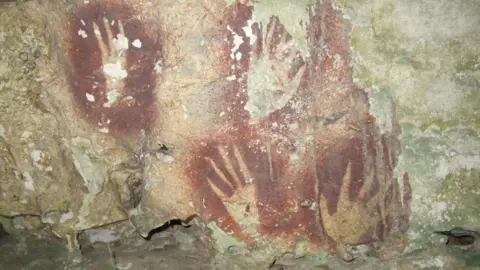
It shows a red outline of a hand whose fingers were reworked to create a claw-like motif, indicating an early leap in symbolic imagination.
The painting has been dated to at least 67,800 years ago—around 1,100 years before the previous record, a controversial hand stencil in Spain.
This find strengthens the argument that our species, Homo sapiens, reached the wider Australia-New Guinea landmass (known as Sahul) well before previously suggested timelines.
Over the last decade, discoveries in Sulawesi have upended the belief that art and abstract thinking flourished only in Ice Age Europe and spread from there.
Cave art represents a significant marker of how humans began to think in abstract, symbolic ways—a cognitive leap that underpins language, religion, and science.
Professor Adam Brumm from Griffiths University, who co-led the research, emphasizes that this latest discovery challenges the perception of a creative awakening in Europe. Instead, it suggests that human creativity existed far earlier and was rooted in Africa, where our species originated.
The oldest known Spanish cave art is a red hand stencil in Maltravieso Cave, dated at least to 66,700 years ago, though some experts contest its dating.
Previous discoveries in Sulawesi included hand stencils and animal figures, the most significant being a hunting scene at least 44,000 years old.
The recent finding comes from a limestone cave called Liang Metanduno, located on Muna—a small island off Sulawesi's southeastern coast. This cave features ancient paintings created by spraying pigment around a hand pressed against the cave wall, leaving a negative outline.
The newly analyzed hand stencil, which is overlain by mineral crusts indicating it is at least 67,800 years old, has become the oldest reliably dated cave art globally.
Research suggests the artist innovatively modified the outline of their fingers to create a more claw-like appearance, a form of creative transformation not seen in Neanderthal art.
This significant timeline shift provides crucial evidence regarding when humans traveled to Sahul, with implications that Homo sapiens likely settled in northern Australia about 65,000 years ago.
These findings indicate that rather than a sudden emergence of creative capabilities, our ancestors showcased sophisticated symbolic behavior much earlier than previously thought, reshaping our understanding of human history and creativity.