In brief
For the first time, researchers at Oregon Health and Science University have developed early-stage human embryos utilizing DNA taken from skin cells. This innovative method promises to address infertility challenges, particularly from aging or disease, and extends possibilities for same-sex couples to have genetically related children. Although the technique is still in its nascent stages and requires further refinement, it represents a significant leap in reproductive science. Experts stress the importance of public dialogue regarding these advancements as potential implications unfold.
US scientists have, for the first time, made early-stage human embryos by manipulating DNA taken from people's skin cells and then fertilising it with sperm.
The technique could overcome infertility due to old age or disease, by using almost any cell in the body as the starting point for life.
It could even allow same-sex couples to have a genetically related child.
The method requires significant refinement - which could take a decade - before a fertility clinic could even consider using it.
Experts said it was an impressive breakthrough, but there needed to be an open discussion with the public about what science was making possible.
Reproduction used to be a simple story of man's sperm meets woman's egg. They fuse to make an embryo, and nine months later a baby is born.
Now scientists are changing the rules. This latest experiment starts with human skin.
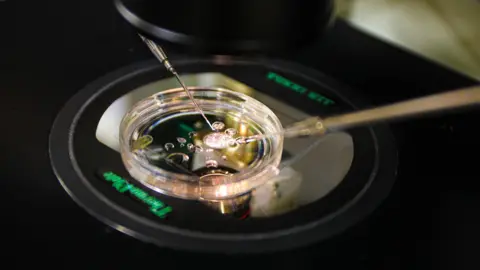
The Oregon Health and Science University research team's technique takes the nucleus – which houses a copy of the entire genetic code needed to build the body – out of a skin cell.
This is then placed inside a donor egg that has been stripped of its genetic instructions.
So far, the technique is like the one used to create Dolly the Sheep – the world's first cloned mammal – born back in 1996.
However, this egg is not ready to be fertilised by sperm as it already contains a full suite of chromosomes.
You inherit 23 of these bundles of DNA from each of your parents for a total of 46, which the egg already has.
So the next stage is to persuade the egg to discard half of its chromosomes in a process the researchers have termed mitomeiosis (the word is a fusion of mitosis and meiosis, the two ways cells divide).
The study, published in the journal Nature Communications, showed 82 functional eggs were made. These were fertilised with sperm and some progressed onto the early stages of embryos development. None were developed beyond the six-day-stage.
We achieved something that was thought to be impossible, said Prof Shoukhrat Mitalipov, the director of the Oregon Health and Science University's centre for embryonic cell and gene therapy.
The technique is far from polished as the egg randomly chooses which chromosomes to discard. It needs to end up with one of each of the 23 types to prevent disease, but ends up with two of some and none of others.
There is also a poor success rate (around 9%) and the chromosomes miss an important process where they rearrange their DNA, called crossing over.
This technology is part of a growing field aiming to make sperm and eggs outside of the body, known as in vitro gametogenesis.
The approach is still at the level of scientific discovery rather than clinical use, but the vision is to help couples who cannot benefit from IVF (in vitro fertilisation) because they don't have the sperm or eggs to use.
It could help older women who no longer have viable eggs, men who don't produce enough sperm or people whose cancer treatment has left them infertile.
Prof Mitalipov emphasized, we have to perfect it. Eventually, I think that's where the future will go because there are more and more patients that cannot have children.