In brief
Dr. Anas al-Hourani and his team at the Syrian Identification Centre are confronting the challenging task of identifying remains from mixed mass graves, believed to hold victims of the Assad regime. As civil war atrocities linger in memory, the families of the disappeared continue to seek answers amid a backlog of identification work hampered by resource constraints.
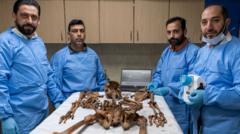
---"These," states Dr. Anas al-Hourani with a heavy heart, "are from a mixed mass grave." As head of the newly opened Syrian Identification Centre in Damascus, he stands beside tables that hold 64 femurs, methodically arranged. Each table has its thigh bones numbered, marking the beginning of a painstaking process aimed at seeking justice for Syria’s atrocities during a brutal 13-year civil war. The bones likely belong to some of the hundreds of thousands thought to have perished under the regimes of former President Bashar al-Assad and his father Hafez. With many remains buried in stacks within these "mixed mass graves," the identification team is confronted with the grim reality that these victims died within the last year.Dr. al-Hourani, who specializes in forensic odontology, emphasizes the value of dental examination, stating, "Teeth can reveal much about a body." This knowledge is crucial, especially when conventional DNA analysis is stymied by limited resources and the scarcity of testing facilities in Syria. After years of conflict, Syria is left with just one fully operational DNA testing laboratory, hampered further by sanctions making essential chemicals and equipment difficult to procure.Current costs rank high, with DNA tests priced at around $250 each. Given the scale of the task, where identifying a single body from a mixed mass grave may require at least 20 tests, financial support from organizations like the International Committee of the Red Cross is essential for progress.While the new leadership of Islamist factions emphasizes "transitional justice," the families of the missing continue to voice their frustrations. Many lost loved ones during the tumult of civil unrest, and according to estimates, over 130,000 people have been forcibly disappeared. The long identification process, marked by extreme duress and uncertainty, could take years before meaningful results are seen.Evidence of the atrocities unfolds beyond the lab. At a recently accessed mass grave site located in a remote area outside Damascus, traces of the past linger. Hussein Alawi al-Manfi, commonly known as Abu Ali, recounts his time as a military driver, where his chilling cargo often consisted of civilian bodies. For over a decade, he transported countless corpses to various burial sites, witnessing firsthand the horrors inflicted by the Assad regime.Meanwhile, Malak Aoude, a mother who returned to Damascus after years of refuge in Turkey, still grapples with the pain of her sons’ disappearances. Both were captured during the early years of the uprising, and as she revisits the school they attended, hope and despair clash. Despite the fall of Assad’s regime, the search for her sons continues, revealing the frustrating reality for many families seeking closure amidst the remnants of the past.As Dr. al-Hourani encapsulates the laborious future ahead for the identification centre, he affirms, "This will be the work of many, many years."